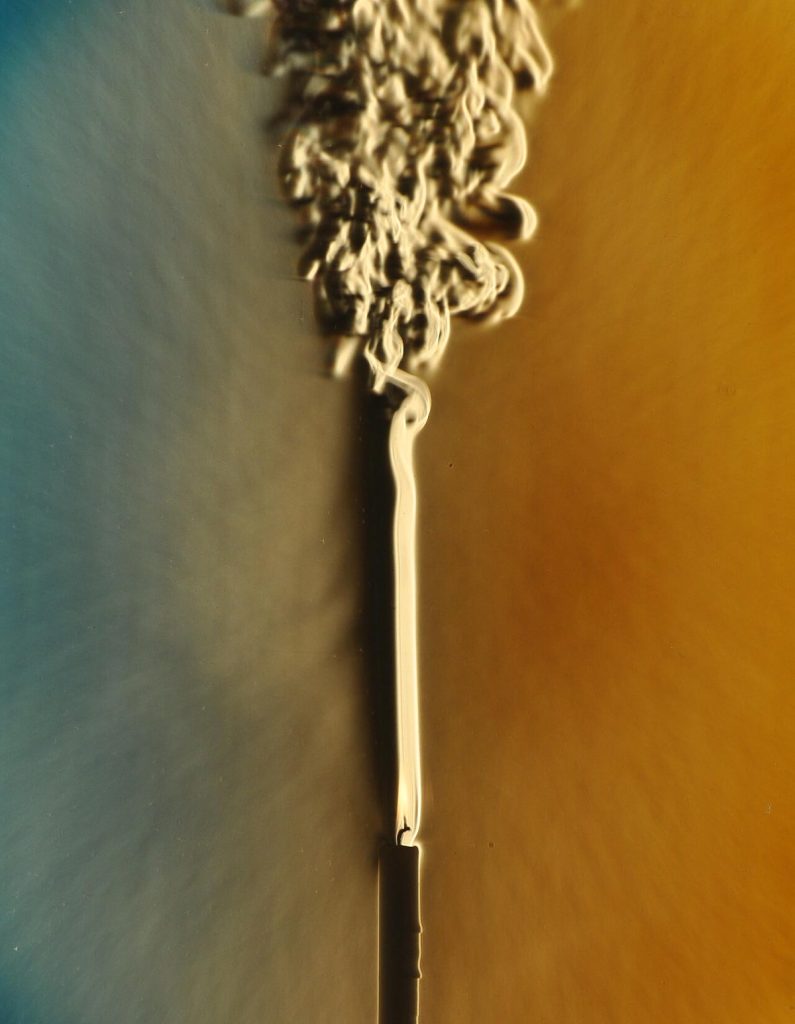
Turbulent vs laminar flow is a question of order versus chaos in a moving fluid. In laminar flow, fluid slides in smooth, parallel layers, while in turbulent flow it swirls in eddies and mixes strongly. Engineers usually tell the two apart using a number called the Reynolds number.
Key takeaways
- Laminar flow is smooth and predictable; turbulent flow is irregular and mixes the fluid.
- The Reynolds number compares inertial forces to viscous forces and predicts which regime applies.
- Turbulence increases drag and friction but improves mixing and heat transfer.
- In a round pipe, flow is usually laminar below a Reynolds number of about 2,300 and turbulent above about 4,000.
- Between those values the flow is transitional and can switch unpredictably.
What is laminar flow?
In laminar flow, fluid particles follow smooth paths, and neighbouring layers slide past one another with little mixing. It tends to happen at low speeds, in thick (viscous) fluids, or in very small channels. Honey pouring from a spoon, or a slow, steady trickle of water from a tap, are familiar examples.
Because laminar flow is orderly, it is easier to predict mathematically. In a straight pipe, the fluid moves fastest in the centre and slowest next to the wall, where friction holds it back, giving a smooth parabolic velocity profile.
What is turbulent flow?
Turbulent flow is chaotic. The velocity and pressure fluctuate irregularly, and swirling eddies of many sizes form and break up. This mixes the fluid thoroughly, spreading heat, dissolved substances and momentum much faster than laminar flow can. A fast-flowing river, smoke rising from a bonfire and air rushing around a car are common examples.
Turbulence is hard to model exactly, so engineers use statistical methods and computer simulations to estimate its behaviour. It remains one of the great unsolved problems of classical physics.
The Reynolds number explained
The Reynolds number (Re) is a dimensionless number that compares inertial forces, which tend to keep fluid moving and create eddies, with viscous forces, which damp out disturbances. For flow in a pipe, it is calculated as density times velocity times diameter, divided by dynamic viscosity.
- Low Re: viscous forces dominate, so the flow is smooth and laminar.
- High Re: inertial forces dominate, so small disturbances grow into turbulence.
The Reynolds number is named after the engineer and physicist Osborne Reynolds, who studied the transition in pipe flow in the 19th century. You can read more on the Wikipedia page for the Reynolds number.
Rule-of-thumb values for pipes
| Reynolds number (circular pipe) | Typical flow regime |
|---|---|
| Below about 2,300 | Laminar |
| About 2,300 to 4,000 | Transitional |
| Above about 4,000 | Turbulent |
These thresholds are guides, not hard limits. Rough pipe walls, vibrations, bends and inlet conditions can trigger turbulence sooner, while very clean, smooth setups can keep flow laminar at higher values.
Key differences at a glance
| Feature | Laminar flow | Turbulent flow |
|---|---|---|
| Motion | Smooth, layered | Chaotic, with eddies |
| Mixing | Very little | Strong |
| Friction and drag | Lower in many cases | Higher |
| Heat transfer | Slower | Faster |
| Predictability | High | Low, statistical |
| Typical Re | Low | High |
Where each type matters
Where laminar flow is useful
- Microfluidic devices and lab-on-a-chip technology, where predictable flow is vital.
- Lubrication films in bearings.
- Blood flow in small vessels, which is typically smooth.
- Clean rooms and some laboratory hoods, which use controlled smooth airflow to carry particles away.
Where turbulent flow is useful
- Mixing chemicals in industrial reactors and stirred tanks.
- Heat exchangers and radiators, where fast heat transfer is the goal.
- Engine intakes and combustion chambers.
- Golf ball dimples, which create a thin turbulent layer that can reduce drag and help the ball travel further.
How to check which regime you have
- Gather the fluid’s density and dynamic viscosity at the operating temperature.
- Measure the average velocity and a characteristic length, such as the inner diameter of the pipe.
- Calculate Re using density times velocity times diameter, divided by viscosity.
- Compare the result with accepted thresholds for your geometry.
- If Re is near a threshold, assume transitional behaviour and design with a safety margin.
Remember that temperature changes viscosity. A hot oil can be much less viscous than a cold one, so the same pipe can switch regimes depending on conditions.
Common misconceptions
- Turbulent always means fast and violent. Not necessarily. A slow flow in a wide pipe of thin fluid can still be turbulent if the Reynolds number is high enough.
- Laminar flow means no mixing at all. There is still molecular diffusion, but it is very slow compared with turbulent mixing.
- One Reynolds number fits every shape. The critical value depends on geometry. Flow over a flat plate or around a sphere has different thresholds from flow in a pipe.
- Turbulence is always bad. It increases drag, but it also improves mixing, cooling and, in some cases, helps flow stay attached to a surface.
A simple way to see it at home
Open a tap very slightly so that the water falls in a clear, glassy stream. That is close to laminar flow. Open it further, and the stream becomes rough, noisy and cloudy with air as it turns turbulent. A candle or incense stick shows the same effect: smoke first rises in a smooth thread, then breaks into curling eddies higher up.
Fluid behaviour even touches health topics. Our guide to RN vs LVN scope of practice looks at the human side of care, while the physics here explains why turbulent airflow can cause noise in breathing or blood flow around narrowed vessels.
Frequently asked questions
What causes turbulent flow?
High speed, low viscosity, large dimensions or rough surfaces make small disturbances grow, producing eddies. This is described by a high Reynolds number.
Is laminar flow better than turbulent flow?
Neither is better in general. Laminar flow gives low mixing and predictable behaviour, while turbulent flow gives strong mixing and faster heat transfer at the cost of more drag.
What is transitional flow?
It is the in-between regime where the flow has bursts of turbulence that come and go. It is hard to predict and best avoided in precise designs.
Does the Reynolds number apply to air?
Yes. It applies to any fluid, including liquids and gases, as long as you use the right density, viscosity, speed and length.
Why do aeroplane wings care about this?
Whether the thin layer of air near the wing is laminar or turbulent changes drag and the point at which the air separates from the surface, which affects efficiency and stall behaviour.
Conclusion
The difference between laminar and turbulent flow comes down to how smoothly a fluid moves, and the Reynolds number gives a practical way to predict it. Once you know the regime, you can understand drag, mixing and heat transfer, and design pipes, vehicles and devices accordingly.
Key takeaways about turbulent vs laminar flow
Here is a short summary of turbulent vs laminar flow so you can find the main points quickly.
- Turbulent vs laminar flow is a question of order versus chaos in a moving fluid.
- In laminar flow, fluid particles follow smooth paths, and neighbouring layers slide past one another with little mixing.
- Because laminar flow is orderly, it is easier to predict mathematically.
- Turbulence is hard to model exactly, so engineers use statistical methods and computer simulations to estimate its behaviour.
If you only remember one thing about turbulent vs laminar flow, make it the practical steps covered in this guide.
Check official sources before acting on anything related to turbulent vs laminar flow, because details can change over time.
Questions about turbulent vs laminar flow are common, so it helps to compare more than one trustworthy source.
Use this page as a starting point for turbulent vs laminar flow and come back to it when your situation changes.
Good decisions about turbulent vs laminar flow come from checking the facts, comparing your options and taking your time.
Save this guide to turbulent vs laminar flow so you can find it again whenever you need a quick reminder.
Related reading:
For general background, you can look up turbulent vs laminar flow on Wikipedia.