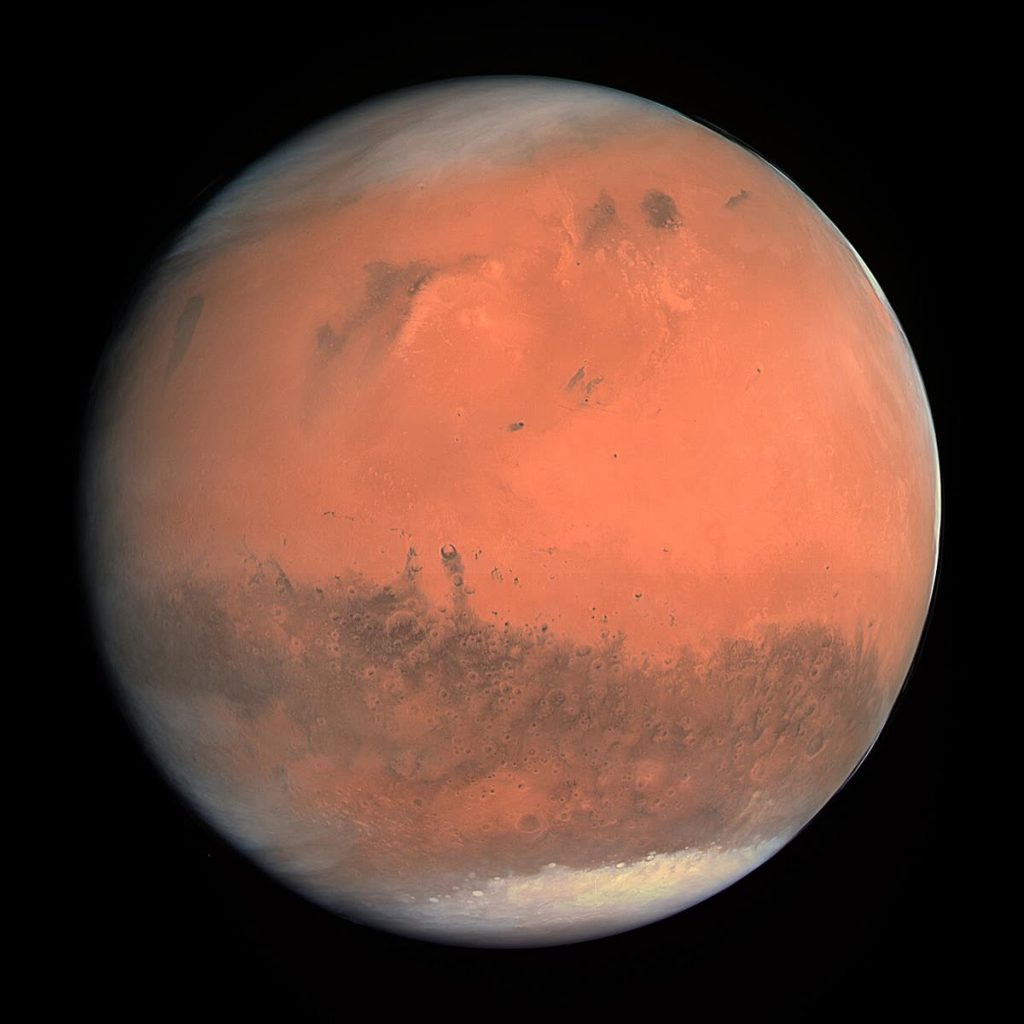
The distance of Mars from the Sun in km averages about 227.9 million kilometres, which is roughly 1.52 astronomical units (AU). Because Mars follows an oval orbit, the distance changes during its year, from about 206.6 million km at its closest point to about 249.2 million km at its farthest. This guide explains those numbers, how they compare with Earth, why they matter and how to work out related figures yourself.
Key takeaways
- Mars averages about 227.9 million km from the Sun, or about 1.52 AU.
- Its distance ranges from roughly 206.6 million km (perihelion) to roughly 249.2 million km (aphelion).
- Sunlight takes about 12 to 13 minutes to reach Mars on average, compared with about 8 minutes for Earth.
- Values are rounded and vary slightly between sources.
Distance of Mars from the Sun in km: the key figures
| Measure | Distance from the Sun (km) | In AU (approx.) |
|---|---|---|
| Closest point (perihelion) | about 206.6 million | 1.38 |
| Average distance | about 227.9 million | 1.52 |
| Farthest point (aphelion) | about 249.2 million | 1.67 |
These are rounded values in line with standard astronomical references such as those published by NASA. Different sources may round them slightly differently, so you might see 227.9, 227.94 or 228 million km quoted for the average.
What is an astronomical unit?
An astronomical unit is a convenient yardstick defined as the average distance between the Earth and the Sun, about 149.6 million km. Distances inside the Solar System are often given in AU because the numbers are then small and easy to compare. Mars at 1.52 AU is therefore a little over one and a half times as far from the Sun as Earth.
To convert, multiply the AU value by 149.6 million km. For Mars: 1.52 × 149.6 million is about 227.4 million km, close to the quoted average once you allow for rounding.
How Mars compares with Earth and other planets
| Planet | Average distance from the Sun (million km) |
|---|---|
| Mercury | about 58 |
| Venus | about 108 |
| Earth | about 150 |
| Mars | about 228 |
| Jupiter | about 778 |
Mars is the fourth planet from the Sun and the outermost of the rocky inner planets. Beyond it lies the asteroid belt, then Jupiter. Because it is farther out, Mars is colder and receives noticeably less sunlight than Earth. Using the inverse-square law, which says light intensity falls with the square of distance, Mars receives roughly 43 percent of the sunlight Earth gets on average, since 1 divided by 1.52 squared is about 0.43.
Why does the distance change?
Planets orbit in ellipses, not perfect circles. The Sun sits at one focus of the ellipse, so the distance varies as the planet travels. Mars has a more elongated orbit than Earth, so the gap between its nearest and farthest points is large: around 42 million km, compared with about 5 million km for Earth.
- Perihelion: the closest point to the Sun, when Mars moves fastest.
- Aphelion: the farthest point, when Mars moves slowest.
- Orbital period: one Martian year lasts about 687 Earth days.
This uneven orbit gives Mars lopsided seasons. The southern hemisphere has a shorter, hotter summer when Mars is near perihelion, and a long, cold winter near aphelion. It is also linked to the dust storms that can grow large around that time of year. For a broader picture, see the Mars article on Wikipedia.
How long does sunlight take to reach Mars?
Light travels at about 299,792 km per second. You can calculate travel time by dividing the distance by that speed.
- Take the distance: 227.9 million km, or 227,900,000 km.
- Divide by the speed of light: 227,900,000 ÷ 299,792 is about 760 seconds.
- Convert to minutes: 760 ÷ 60 is about 12.7 minutes.
At perihelion the figure is about 11.5 minutes and at aphelion about 13.9 minutes. For Earth, the average is about 8 minutes and 20 seconds.
Distance from the Sun is not distance from Earth
People often confuse these two. The distance between Earth and Mars changes much more, because both planets are moving. At their closest approach it can be around 55 million km in the best cases, and at their farthest, when the Sun is between them, it can exceed 400 million km. Missions to Mars are timed to launch during windows roughly every 26 months, when the planets are favourably aligned. Updates on missions and exploration are available on the NASA website.
Why the distance matters
- Climate: less sunlight means lower average temperatures, around minus 60 degrees Celsius on average, though this varies widely with place and season.
- Solar power: spacecraft on Mars get less solar energy than on Earth, which affects rovers and landers.
- Communication delay: signals take minutes to travel between Earth and Mars, so rovers need some autonomy.
- Orbit planning: mission designers use these distances to plan fuel and travel time.
If you enjoy science explainers, you might also like our guide on laminar versus turbulent flow, which breaks down a physics idea in plain English.
Frequently asked questions
How far is Mars from the Sun in miles?
The average is about 141.6 million miles. To convert kilometres to miles, multiply by 0.621.
What is the closest Mars gets to the Sun?
About 206.6 million km, at perihelion, or roughly 1.38 AU.
What is the farthest Mars gets from the Sun?
About 249.2 million km, at aphelion, or roughly 1.67 AU.
Is Mars always the same distance from Earth?
No. The Earth-Mars distance changes constantly because both planets orbit the Sun at different speeds, ranging from tens of millions to hundreds of millions of kilometres.
Why do different websites give slightly different numbers?
Because values are rounded differently and some sources use mean orbital values while others use specific dates. The differences are small and do not change the overall picture.
Conclusion
The distance of Mars from the Sun in km averages about 227.9 million, ranging from roughly 206.6 million at perihelion to 249.2 million at aphelion. That puts Mars about 1.52 AU from the Sun, where sunlight is weaker and the year lasts 687 Earth days. With a simple division, you can also work out how long light takes to travel there, and why the distance to Earth is a separate and much more variable figure.
Key takeaways about distance of mars from the sun in km
Here is a short summary of distance of mars from the sun in km so you can find the main points quickly.
- The distance of Mars from the Sun in km averages about 227.9 million kilometres, which is roughly 1.52 astronomical units (AU).
- These are rounded values in line with standard astronomical references such as those published by NASA.
- An astronomical unit is a convenient yardstick defined as the average distance between the Earth and the Sun, about 149.6 million km.
- To convert, multiply the AU value by 149.6 million km.
Check official sources before acting on anything related to distance of mars from the sun in km, because details can change over time.
Questions about distance of mars from the sun in km are common, so it helps to compare more than one trustworthy source.
Use this page as a starting point for distance of mars from the sun in km and come back to it when your situation changes.
Related reading:
For general background, you can look up distance of mars from the sun in km on Wikipedia.