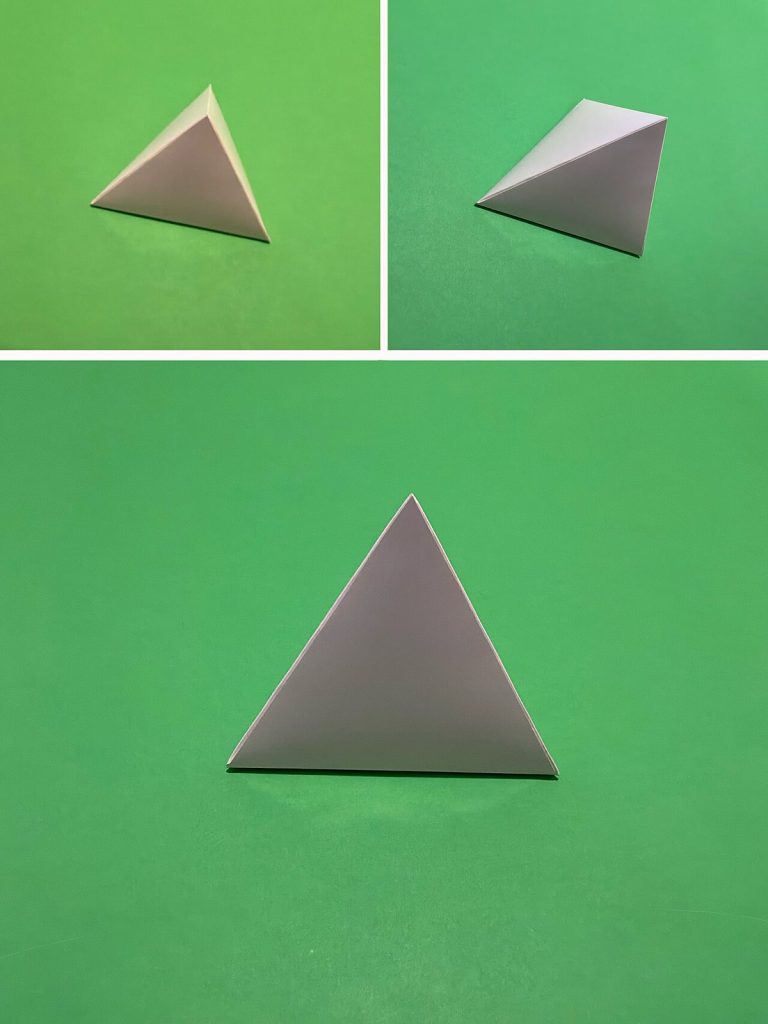
How many vertices does a triangular pyramid have? Exactly 4. A triangular pyramid also has 6 edges and 4 triangular faces, and it is better known as a tetrahedron, the simplest of all pyramids. Below we explain how to count each part, how it compares with other pyramids, and how to avoid the common mistakes.
Key takeaways
- A triangular pyramid has 4 vertices, 6 edges and 4 faces.
- Every face is a triangle, including the base, so any face can be called the base.
- Euler’s formula, V – E + F = 2, works for it: 4 – 6 + 4 = 2.
- For a pyramid with an n-sided base there are n + 1 vertices.
Counting the vertices of a triangular pyramid
A vertex is a corner where edges meet. In a triangular pyramid, three vertices form the triangular base, and a fourth vertex, called the apex, sits above the base. Each of the three base corners joins the apex with a slanted edge, and the three sides of the base are edges too.
| Part | Number |
|---|---|
| Vertices (corners) | 4 |
| Edges | 6 |
| Faces | 4 (all triangles) |
Counting step by step
- Draw or picture a triangle as the base. It has 3 corners and 3 sides.
- Choose a point above the triangle. This is the apex, giving a fourth vertex.
- Join the apex to each of the 3 base corners. That adds 3 slanted edges, making 6 edges in total.
- Count the faces: one base triangle plus three side triangles, giving 4.
Why a triangular pyramid is a tetrahedron
The word tetrahedron comes from Greek words meaning “four faces”. A triangular pyramid has exactly four triangular faces, so the two names describe the same shape. When all four faces are equilateral triangles of the same size, it is called a regular tetrahedron, which is one of the five Platonic solids. You can read more at Wikipedia’s Tetrahedron article.
Because every face is a triangle and every vertex touches the other three, you can turn the shape over and any face can serve as the base. That is a special property that does not hold for other pyramids.
Euler’s formula check
For any convex polyhedron, the number of vertices (V) minus the number of edges (E) plus the number of faces (F) equals 2. For a triangular pyramid this gives 4 – 6 + 4 = 2. This is a handy way to check your counting. If you have found a different total, one of your counts is off.
Comparing pyramids
The number of vertices depends on the shape of the base. A pyramid with a base of n sides has n + 1 vertices, 2n edges and n + 1 faces.
| Pyramid | Base sides | Vertices | Edges | Faces |
|---|---|---|---|---|
| Triangular | 3 | 4 | 6 | 4 |
| Square | 4 | 5 | 8 | 5 |
| Pentagonal | 5 | 6 | 10 | 6 |
| Hexagonal | 6 | 7 | 12 | 7 |
The same rule is shown in more depth on Wikipedia’s page for pyramids in geometry.
Common mistakes
- Forgetting the apex. Students often count only the three base corners and say 3.
- Confusing a triangular pyramid with a triangular prism. A triangular prism has 6 vertices, 9 edges and 5 faces.
- Counting hidden edges twice. In diagrams, dashed lines show edges at the back. They still count, so there are 6 in total.
- Mixing up base shapes. The pyramid is named for its base, so a square pyramid has 5 vertices, not 4.
Where you see triangular pyramids
Tetrahedral shapes appear in dice, in tents and in chemistry. The methane molecule has a tetrahedral arrangement of atoms. Four-sided dice used in tabletop games are tetrahedrons, and some kites and structural frames use the shape because it is rigid. Triangles resist bending, so this shape is strong for its weight.
Measurement skills help in practical projects too. If you are building models or cooking with weights and conversions, our guide on how many ounces in a quarter pound is a handy companion.
Quick tips for teaching or revising
- Build a model with straws and modelling clay: four balls of clay for vertices and six straws for edges.
- Count while turning the model so that no edge is missed.
- Use colours: mark the apex one colour and the base corners another.
- Check with Euler’s formula at the end.
Volume and surface area
Once you know the parts, the next questions are usually about size. The volume of any pyramid is one third of the base area multiplied by the perpendicular height. For a triangular pyramid, find the area of the triangular base (half the base length times the triangle’s height) and then apply the one-third rule.
For a regular tetrahedron with every edge of length a, the surface area is the square root of 3 times a squared, because it is made of four equilateral triangles. The volume is a cubed times the square root of 2, divided by 12. If your teacher only asks for the count of vertices, edges and faces, you can skip these formulas, but they are useful for later work.
Drawing the net
A net is a flat pattern that folds into the solid. The net of a tetrahedron is four triangles joined in a larger triangle, with three triangles around a central one. Cut it out, fold along the shared edges and tape the free edges. Folding the net is a quick way to see that there are four faces, six edges and four corners.
Practice questions
- How many vertices does a tetrahedron have? Answer: 4.
- A pyramid has a hexagonal base. How many vertices does it have? Answer: 7.
- If a pyramid has 10 edges, what shape is its base? Answer: a pentagon, since edges equal twice the number of base sides.
Frequently asked questions
How many vertices does a triangular pyramid have?
It has 4 vertices: three at the base and one at the apex.
How many edges does a triangular pyramid have?
It has 6 edges: three on the base and three slanting up to the apex.
How many faces does it have?
It has 4 faces, all of them triangles.
Is a tetrahedron the same as a triangular pyramid?
Yes. Tetrahedron is the geometric name for a solid with four triangular faces.
How many vertices does a square pyramid have?
It has 5 vertices: four on the square base and one apex.
Conclusion
A triangular pyramid has 4 vertices, 6 edges and 4 faces. Remember the apex, remember the hidden edges, and use Euler’s formula as a final check. Once you see the pattern of n + 1 vertices for an n-sided base, counting parts of any pyramid becomes easy.
Key takeaways about how many vertices does a triangular pyramid have
Here is a short summary of how many vertices does a triangular pyramid have so you can find the main points quickly.
- How many vertices does a triangular pyramid have?
- A vertex is a corner where edges meet.
- The word tetrahedron comes from Greek words meaning "four faces".
- Because every face is a triangle and every vertex touches the other three, you can turn the shape over and any face can serve as the base.
If you only remember one thing about how many vertices does a triangular pyramid have, make it the practical steps covered in this guide.
Check official sources before acting on anything related to how many vertices does a triangular pyramid have, because details can change over time.
Questions about how many vertices does a triangular pyramid have are common, so it helps to compare more than one trustworthy source.
Use this page as a starting point for how many vertices does a triangular pyramid have and come back to it when your situation changes.
Related reading:
- Is Dolly Parton Still Alive? Checking the Rumours
- Autobahn Without a Speed Limit: Where Germany’s Unrestricted Sections Are
For general background, you can look up how many vertices does a triangular pyramid have on Wikipedia.