Common convex lens examples include magnifying glasses, spectacles for long-sightedness, camera lenses, microscopes, telescopes, projectors and even the lens inside your own eye. A convex lens is thicker in the middle than at the edges, and it bends light rays inwards so that they meet at a point. That simple shape is behind much of the technology we use to see small, distant or faint things.
Key takeaways
- A convex (converging) lens is thicker at the centre and focuses parallel light rays to a point.
- Everyday examples include magnifiers, glasses for long sight, cameras, binoculars and the eye itself.
- The image can be real or virtual, upright or inverted, depending on where the object sits relative to the focal point.
- A concave lens does the opposite: it spreads light out and is used for short-sightedness.
How a convex lens works
When light passes from air into glass or clear plastic, it slows down and changes direction. This bending is called refraction. In a convex lens, both surfaces curve outwards, so rays hitting the upper part bend downwards and rays hitting the lower part bend upwards. Parallel rays from a distant object end up crossing at the focal point, and the distance from the lens to this point is the focal length.
A fatter, more curved lens bends light more strongly and has a shorter focal length. A flatter lens bends it more gently and has a longer one. This is why a strong magnifying glass looks noticeably domed while a weak one looks nearly flat. You can read more about lenses in general in the Wikipedia article on lenses.
Everyday convex lens examples
Magnifying glass
Hold a magnifier close to a page and the text appears larger. When the object is closer to the lens than the focal point, the lens produces an enlarged, upright, virtual image. You are not seeing light converge on a screen, but your eye perceives the larger picture behind the lens.
Spectacles for long-sightedness
People who are long-sighted (hypermetropia) find it hard to focus on near objects because the eye does not bend light enough. Convex lenses in glasses or contact lenses add extra focusing power so the image lands on the retina. An optician can measure your prescription with an eye test.
Cameras
Camera lenses are usually built from several elements, many of them convex, to produce a sharp real image on the sensor or film. Combining elements also corrects colour fringing and distortion, which a single simple lens would show.
Microscopes and telescopes
A compound microscope uses at least two convex lenses: an objective close to the specimen and an eyepiece near your eye. A refracting telescope also uses convex lenses, with a large objective gathering light and a smaller eyepiece magnifying the image. Binoculars combine lenses with prisms to give an upright view.
Projectors and overhead displays
Projectors use convex lenses to focus an image onto a screen, where it forms a real image that many people can see at once.
The human eye
The eye has a flexible convex lens behind the pupil. Tiny muscles change its shape so you can focus on near or far objects, a process called accommodation. With age, the lens stiffens, which is why many people need reading glasses in middle age.
Image types at a glance
The kind of image a convex lens forms depends on where the object is. This table summarises the usual cases for a single thin lens.
| Object position | Image | Typical use |
|---|---|---|
| Beyond twice the focal length | Real, inverted, smaller | Camera |
| At twice the focal length | Real, inverted, same size | Photocopying set-ups |
| Between one and two focal lengths | Real, inverted, larger | Projector |
| At the focal point | Image at infinity | Searchlight style beams |
| Closer than the focal length | Virtual, upright, larger | Magnifying glass |
A real image can be caught on a screen, while a virtual image cannot, though your eye can still see it through the lens.
Convex versus concave lenses
A concave lens is thinner in the middle and thicker at the edges. It makes parallel rays spread out, so it is called a diverging lens. Concave lenses are used in glasses for short-sightedness (myopia), in peepholes in doors and in some camera and telescope designs where they help correct errors from convex elements. If you remember one thing, remember that convex lenses converge and concave lenses diverge.
A simple experiment you can try
You can see a convex lens at work with a magnifying glass and a sunny day or a window. Take care with sunlight, because focused rays can burn skin or start fires, so never focus the sun on yourself or flammable materials and never look at the sun through a lens.
- Hold the lens a bit away from a sheet of white paper facing a bright window.
- Move the lens until a sharp, small picture of the window appears on the paper.
- Measure the distance from the lens to the paper. That is an approximation of the focal length.
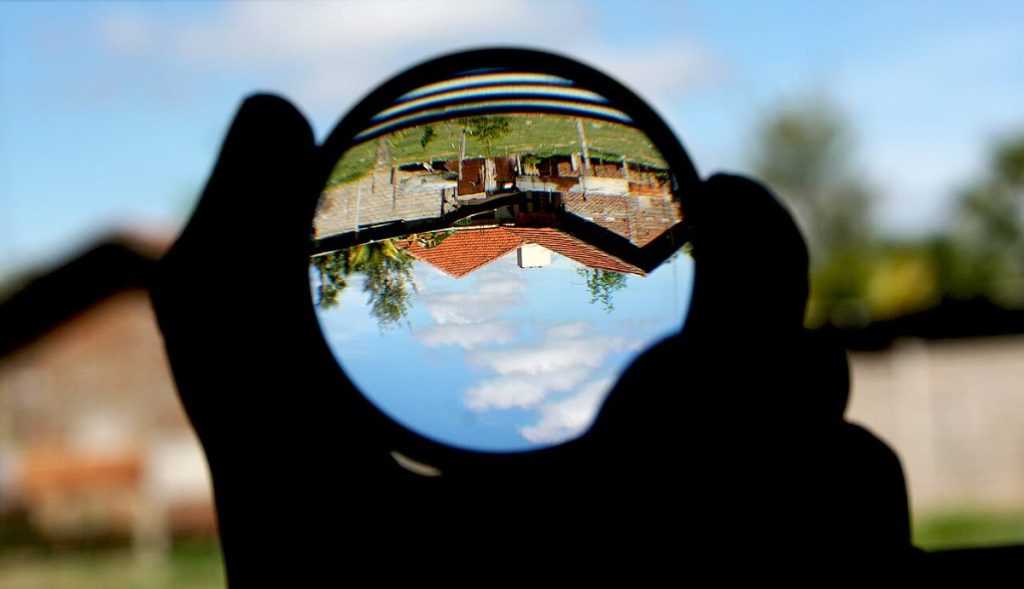
- Notice that the picture is upside down. That is the real, inverted image.
Try again with a thicker or thinner lens to see how the shape changes the focal length. If you enjoy hands-on science, our guide on how a Brita pitcher works explains another everyday device in plain terms, and our piece on multicellular examples is a good next read if you have a microscope handy.
Common mistakes and misconceptions
- Thinking convex always means magnifying. A convex lens only magnifies when the object is inside the focal length. Beyond it, you get a smaller inverted image.
- Mixing up converge and diverge. Convex converges; concave diverges.
- Assuming glasses for everyone use convex lenses. Long-sighted people use convex lenses, while short-sighted people use concave ones.
- Ignoring safety. Concentrated sunlight is dangerous.
Frequently asked questions
What is the simplest example of a convex lens?
A handheld magnifying glass is the classic example. It is thicker in the middle and enlarges small print when held close.
Is the human eye lens convex?
Yes. The eye has a flexible convex lens that changes shape to focus light onto the retina.
Why is a convex lens called a converging lens?
Because it bends parallel light rays towards each other so they converge at the focal point.
Can a convex lens make an upside-down image?
Yes. When the object is beyond the focal length, a convex lens forms a real image that is inverted.
Which lens is used for long-sightedness?
A convex lens. It adds focusing power so near objects can be seen clearly. A qualified optician can test your eyes and advise on a prescription.
Conclusion
From the magnifier on a desk to the lens in your own eye, convex lens examples are everywhere, and they all rely on the same idea: shaping glass or other clear material so that light bends inwards. Once you understand focal length and image types, cameras, telescopes and spectacles all start to make sense.
Key takeaways about convex lens examples
Here is a short summary of convex lens examples so you can find the main points quickly.
- Common convex lens examples include magnifying glasses, spectacles for long-sightedness, camera lenses, microscopes, telescopes, projectors and even the lens inside your own eye.
- When light passes from air into glass or clear plastic, it slows down and changes direction.
- A fatter, more curved lens bends light more strongly and has a shorter focal length.
- Hold a magnifier close to a page and the text appears larger.
Check official sources before acting on anything related to convex lens examples, because details can change over time.
Questions about convex lens examples are common, so it helps to compare more than one trustworthy source.
Use this page as a starting point for convex lens examples and come back to it when your situation changes.
Good decisions about convex lens examples come from checking the facts, comparing your options and taking your time.
Related reading:
- Chilton County Busted: How to Find Arrest Records Safely
- Fig Benefits for Male: What Dried Figs Offer Nutritionally
For general background, you can look up convex lens examples on Wikipedia.