The life cycle of a tiger runs from a tiny, blind cub born in a hidden den to a solitary adult that hunts, defends territory and eventually raises cubs of its own. It is a slow cycle, with cubs depending on their mother for around two years, and it applies to white tigers too, since they are simply tigers with an unusual coat. Here are the stages, typical timelines and the facts that explain why tigers are so vulnerable in the wild.
Key takeaways
- Tiger pregnancy lasts roughly 100 to 110 days, and litters are usually two to four cubs.
- Cubs are born blind and helpless, and stay with their mother for about two years.
- Tigers usually reach breeding age at around three to five years old.
- White tigers are not a separate species; they are tigers with a rare recessive colour variation.
- Wild tigers often live 10 to 15 years, while those in human care can live longer.
Stage one: mating and pregnancy
Tigers are mostly solitary. A female is receptive for only a few days at a time, and a male travelling through her territory will find her by scent and sound. After mating, the female’s pregnancy lasts roughly 100 to 110 days, a little over three months. As the time approaches, she looks for a sheltered den, such as a cave, thick vegetation or a hollow among rocks, away from other tigers.
Most litters have two to four cubs, though single cubs and larger litters do occur. You can read an overview of the species and its range on Wikipedia’s tiger article.
Stage two: newborn cubs
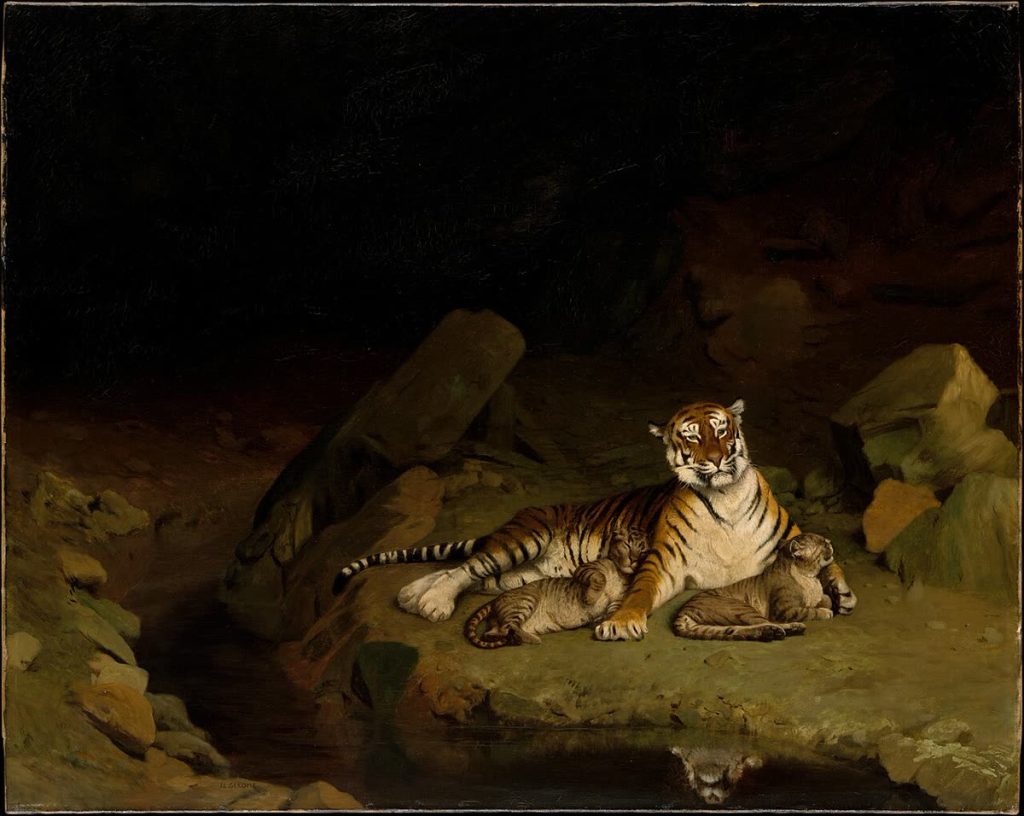
A newborn cub typically weighs somewhere around one kilogram, is covered in a fine coat and cannot see. The eyes usually open within the first two weeks. During this time the mother stays close, nursing frequently, keeping the cubs warm and leaving only to hunt for short periods. Males do not generally help raise the young, and an unfamiliar male can be a threat to cubs, which is one reason the mother hides them.
Cubs grow quickly. They start to crawl, then walk, and by a few weeks old they are exploring the den entrance. Their first milk teeth appear in this period.
Stage three: weaning and learning to hunt
At around two months old, cubs begin to follow their mother out of the den and encounter meat for the first time. They continue to drink milk until about six months. Play is serious business: stalking, pouncing and wrestling build the strength and coordination they will need as hunters. By about six months the mother is bringing back kills for the cubs to feed on and teaching them to track prey.
| Age | What is happening |
|---|---|
| Birth | Blind, helpless, completely dependent on milk |
| 1 to 2 weeks | Eyes open |
| About 2 months | Leaves the den, starts to try meat |
| About 6 months | Weaned, joins hunts |
| 1 to 2 years | Practises hunting skills with mother |
| About 2 years | Leaves the mother to find its own territory |
Stage four: becoming independent
Young tigers, sometimes called sub-adults, leave their mother at around two years old. Dispersal is risky. Females often settle in territories near their mother, but males tend to travel much farther to find an area not already held by a stronger male. During this stage they may struggle to find prey, come into conflict with other tigers, or enter areas used by people. The mortality rate among young tigers is high, which is why many of the cubs in a litter do not survive to adulthood.
Stage five: adulthood and breeding
Females generally reach breeding age at about three to four years, and males slightly later, at four to five. Once a female has cubs, she will usually raise them for around two years before she can breed again, so she may have a litter only every two to three years. An adult tiger needs a large territory with enough prey such as deer and wild pigs, plus water and cover. Territory size varies widely depending on how much prey is available.
In the wild, tigers commonly live around 10 to 15 years, though this depends on habitat, human pressure and health. In zoos and sanctuaries, with veterinary care and a steady food supply, some live into their late teens or early twenties. Check an organisation such as the World Wide Fund for Nature or the IUCN Red List for current population and status data, because numbers change.
Where do white tigers fit in?
Many people searching for the life cycle of a tiger are really asking about white tigers. They follow exactly the same stages as orange tigers. A white tiger is a Bengal tiger with a recessive genetic variation that reduces the orange pigment in the coat, leaving the animal pale with dark stripes. Both parents must carry the gene for a cub to be white. White tigers are not albinos, since they have pigment in their stripes and typically blue eyes.
Wild white tigers are extremely rare. Most in captivity trace back to a small number of animals, and inbreeding to produce white cubs has caused health problems in some lines. Conservation groups emphasise protecting wild habitat rather than breeding colour variants. More detail is available in the Wikipedia article on white tigers.
Threats that shape the tiger’s life cycle
- Habitat loss and fragmentation, which reduces hunting grounds and den sites.
- Poaching for skins and body parts.
- Loss of prey animals due to hunting.
- Conflict with people when tigers and livestock share space.
Because tigers breed slowly, a small number of lost adult females can have a large effect on a local population. If you like time-based explainers, you might enjoy our look at the actual number of days in a year, which is handy when counting how long a gestation or cub-rearing period lasts, and our guide on how a Brita pitcher works for another simple science topic.
Frequently asked questions
How many cubs does a tiger have at once?
Typically two to four, although the number can vary. Some litters have only one cub.
How long does a tiger stay with its mother?
Around two years. During this time the cubs learn to hunt and navigate their territory before dispersing.
Are white tigers a different species?
No. They are Bengal tigers with a rare recessive gene that changes their coat colour.
How long do tigers live?
Often 10 to 15 years in the wild and longer in managed care, though individual lifespans vary.
Do male tigers help raise cubs?
Generally not. Mothers raise cubs alone, and unfamiliar males may be a danger to them.
Conclusion
The life cycle of a tiger is slow and demanding, from a blind newborn to a two-year apprenticeship and, finally, a solitary adult life. White tigers follow the same path with a different coat. Understanding these stages shows why protecting habitat and prey is so important for the species.
Key takeaways about the life cycle of a tiger
Here is a short summary of the life cycle of a tiger so you can find the main points quickly.
- The life cycle of a tiger runs from a tiny, blind cub born in a hidden den to a solitary adult that hunts, defends territory and eventually raises cubs of its own.
- Most litters have two to four cubs, though single cubs and larger litters do occur.
- A newborn cub typically weighs somewhere around one kilogram, is covered in a fine coat and cannot see.
- At around two months old, cubs begin to follow their mother out of the den and encounter meat for the first time.
Good decisions about the life cycle of a tiger come from checking the facts, comparing your options and taking your time.
Save this guide to the life cycle of a tiger so you can find it again whenever you need a quick reminder.
If you only remember one thing about the life cycle of a tiger, make it the practical steps covered in this guide.
Check official sources before acting on anything related to the life cycle of a tiger, because details can change over time.
Related reading:
For general background, you can look up the life cycle of a tiger on Wikipedia.