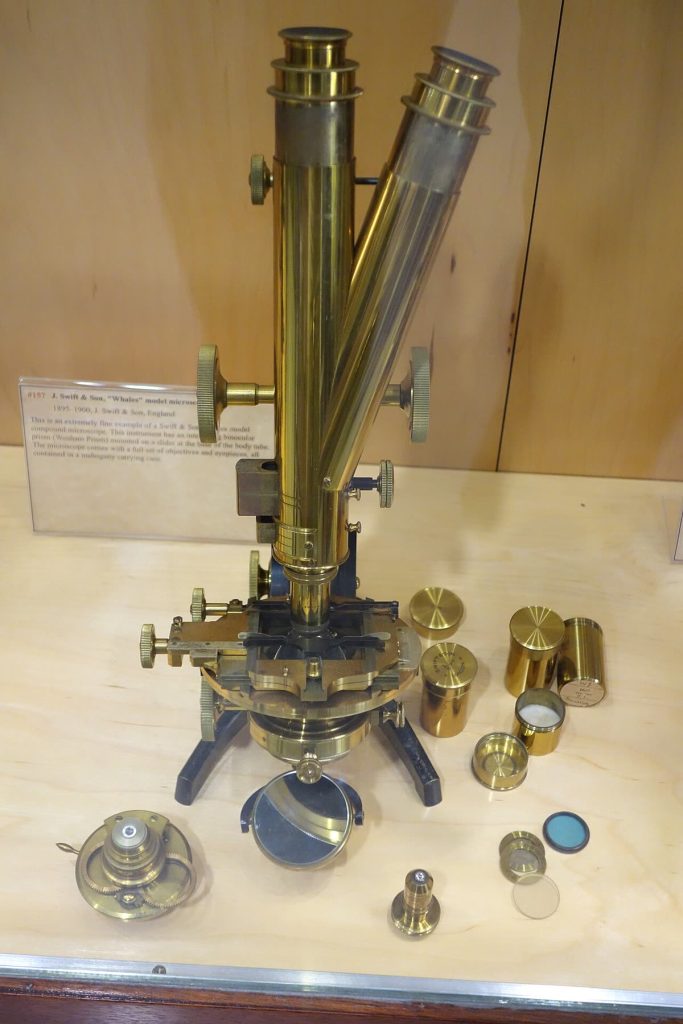
What is the ocular lens on a microscope? It is the eyepiece, the lens at the top of the instrument that you put your eye to. It takes the enlarged image formed by the objective lens and magnifies it a second time for your eye. On most school and laboratory microscopes the ocular is 10x, and total magnification is the ocular power multiplied by the objective power.
Key takeaways
- The ocular lens is the eyepiece; it is the second stage of magnification.
- Total magnification = ocular power x objective power.
- A 10x eyepiece is standard, but 5x, 15x and 20x versions exist.
- Keep the lens clean and handle it by the barrel, never the glass.
How the ocular lens works
A compound microscope magnifies in two stages. The objective lens sits close to the specimen and forms an enlarged image inside the body tube. The ocular lens then magnifies that image again. Using two lenses lets a microscope reach far greater magnification than a single magnifying glass can manage. The ocular also helps to determine your field of view, the circle of the specimen you can see at once, and the comfort of the view, including how far from the lens your eye should rest.
Working out total magnification
| Ocular | Objective | Total magnification |
|---|---|---|
| 10x | 4x | 40x |
| 10x | 10x | 100x |
| 10x | 40x | 400x |
| 10x | 100x | 1000x |
| 15x | 40x | 600x |
The numbers are engraved on the lens barrels. Multiply the two to get the figure. A 10x ocular with a 40x objective gives 400x, and a 15x ocular with a 40x objective gives 600x. More magnification is not always better: the image becomes dimmer and the field of view smaller, and the lens can only reveal details that its optics resolve.
Parts and features of an eyepiece
- Eyepiece barrel. The tube holding the lens elements, which slots into the body tube.
- Eye cup or rubber guard. Blocks stray light and rests against your face. People who wear glasses sometimes fold it down.
- Pointer or reticle. Some eyepieces contain a fine pointer or a measuring scale, used to show a feature or measure a specimen.
- Diopter adjustment. Present on one eyepiece of binocular microscopes, it adjusts for differences between your two eyes.
Monocular, binocular and trinocular
A monocular microscope has one eyepiece, which is simple and common in schools. A binocular design has two, allowing both eyes to relax and reducing fatigue during long sessions. Trinocular microscopes add a third port for a camera. In binocular models the distance between the eyepieces can be adjusted to match the gap between your pupils; if you see two circles that do not merge, slide the barrels closer or further apart until they form one clear circle.
Using the ocular lens: a short routine
- Start at the lowest-power objective and focus with the coarse and then the fine knob. If you want to understand which does what, read our guide to the function of the coarse adjustment knob.
- Look through the eyepiece with both eyes open if you can. This reduces strain.
- On a binocular microscope, adjust the distance between the eyepieces until you see one circle.
- Focus with the right eye (or the fixed eyepiece), then use the diopter ring on the other eyepiece to sharpen the view for that eye.
- Move up in objective power gradually, refocusing with the fine knob only.
Cleaning and care
Dust and fingerprints on the eyepiece show up as dark smudges that follow your eye. Brush loose dust off first with a blower or soft brush, then wipe gently with lens tissue and a drop of lens cleaner, using a circular motion from the centre outwards. Never use paper towels, clothing or household glass cleaner, which can scratch or damage coatings. Keep the microscope covered when not in use, store it in a dry place, and put the eyepieces back if you removed them so dust cannot fall into the tube.
If you notice a dark spot in your view, rotate the eyepiece. If the spot moves, the dirt is on the eyepiece. If it stays put, it is likely on the objective or on the slide.
Troubleshooting what you see
| Problem | Possible cause | What to try |
|---|---|---|
| Dark spot in view | Dust on eyepiece, objective or slide | Rotate the eyepiece to identify the source and clean it |
| Two overlapping circles | Eyepieces not set to your eye spacing | Adjust the distance between the barrels |
| Blurry in one eye | Diopter not set | Focus with one eye, then adjust the diopter |
| Dim, narrow view | High magnification or poor lighting | Adjust the light and iris, or lower the power |
| Shaking image | Loose eyepiece or vibration | Seat the eyepiece firmly, place the microscope on a stable table |
What to look at
Once your equipment is ready, there is a great deal to examine: onion skin, pond water, pollen, fabric fibres or a prepared slide of cells. Adults and children both enjoy looking at tiny creatures, and you can compare a magnified view of a specimen like the creatures covered in our guide to little black oval bugs in the house, although for safety and hygiene you should handle live insects carefully and wash your hands afterwards. For an overview of how the instrument developed and the different designs, the Wikipedia article on the microscope is a good starting point.
Choosing a different eyepiece
Most users never need to change their ocular, but it can be worthwhile. A lower-power eyepiece, such as 5x, gives a wider field of view, which is handy for scanning a slide quickly or following something that moves. A higher-power eyepiece, such as 15x or 20x, enlarges the image further, though it does not add real detail beyond what the objective can resolve. This is sometimes called empty magnification, and it is why serious users spend their money on better objectives rather than stronger eyepieces. Wide-field eyepieces show a larger circle and are more comfortable, and high-eyepoint versions let you keep your glasses on while looking through, since the eye can sit further back from the lens.
Before buying a replacement, check the diameter of the tube on your microscope, usually printed in the manual or easy to find from the model number. Eyepieces designed for one standard will not fit another without an adaptor, and mixing different eyepieces in a binocular head can give uneven views. Buy a matched pair when you can.
Frequently asked questions
Is the ocular lens the same as the eyepiece?
Yes. The terms refer to the same lens. Ocular is the technical name, while eyepiece is the everyday word.
What magnification is a typical ocular lens?
10x is the most common. Others, including 5x, 15x and 20x, are available for certain uses.
How do I calculate total magnification?
Multiply the power of the ocular lens by the power of the objective lens that is in position.
Can I change the ocular lens?
On many microscopes, yes. Eyepieces are removable, but they must be compatible with your model’s tube diameter.
Why is my view circular?
The round field of view is formed by the lens system and the field stop. A larger field number gives a wider view.
Conclusion
The ocular lens is the eyepiece that completes the microscope’s magnification. Know its power, keep it clean, and set your eyes up properly, and the whole instrument gives better, more comfortable views.
Key takeaways about what is the ocular lens on a microscope
Here is a short summary of what is the ocular lens on a microscope so you can find the main points quickly.
- What is the ocular lens on a microscope?
- The numbers are engraved on the lens barrels.
- A monocular microscope has one eyepiece, which is simple and common in schools.
- Dust and fingerprints on the eyepiece show up as dark smudges that follow your eye.
Check official sources before acting on anything related to what is the ocular lens on a microscope, because details can change over time.
Questions about what is the ocular lens on a microscope are common, so it helps to compare more than one trustworthy source.
Use this page as a starting point for what is the ocular lens on a microscope and come back to it when your situation changes.
Good decisions about what is the ocular lens on a microscope come from checking the facts, comparing your options and taking your time.
Save this guide to what is the ocular lens on a microscope so you can find it again whenever you need a quick reminder.
If you only remember one thing about what is the ocular lens on a microscope, make it the practical steps covered in this guide.
Related reading:
- How to Write a Skit: A Step-by-Step Guide for Beginners
- Stages of a Wart Dying with Salicylic Acid Treatment
For general background, you can look up what is the ocular lens on a microscope on Wikipedia.