Here is a clear, practical look at function of coarse adjustment knob in microscope, covering what matters most and what to check before you decide.
The function of the coarse adjustment knob in a microscope is to move the stage, or on some designs the body tube, up and down in large steps so you can bring a specimen roughly into focus. You use it only with the lowest-power objective. Once the image appears, even if blurry, you switch to the fine adjustment knob for sharp focus. Used carelessly on a high-power lens, the coarse knob can drive the objective into the slide.
Key takeaways
- The coarse knob makes big focus movements; the fine knob makes small, precise ones.
- Use the coarse knob only at low power, such as 4x.
- Watch the objective from the side while lowering the stage or tube, not through the eyepiece.
- After changing to a higher power, focus with the fine knob only.
What the coarse adjustment does
When you put a slide on the stage, the specimen is normally too far from the objective lens to be in focus. The coarse knob changes that distance by a large amount per turn, which lets you find the approximate focus quickly. Think of it as setting the approximate distance, while the fine knob sets the exact one. A compound microscope has a very short working distance at high power, sometimes only a millimetre or less, so the coarse knob is simply too crude for that job.
Where to find it
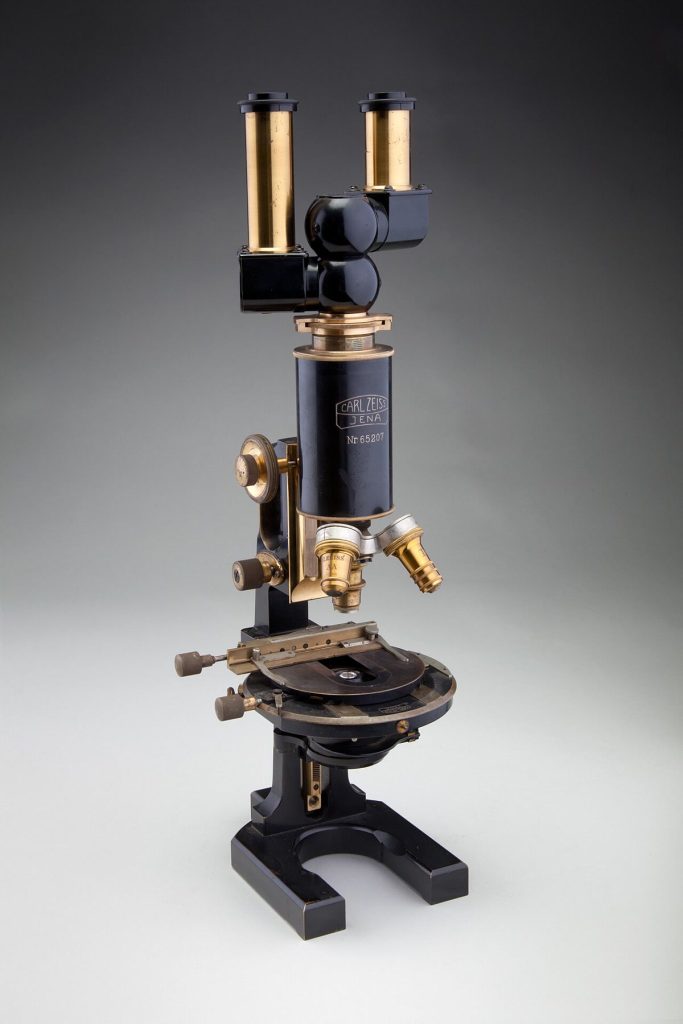
On most compound microscopes, both knobs sit on the arm near the base. The larger knob is the coarse adjustment, and the smaller one is the fine adjustment. In many designs the two share an axis, with the big outer wheel for coarse movement and the smaller inner wheel for fine movement. Others place them separately on each side of the arm. If you are not sure, turn a knob a little while watching the stage: if it moves a lot, it is the coarse one. Your manual will show the layout for your model.
Step-by-step: using the coarse knob safely
- Rotate the nosepiece to the lowest-power objective, often 4x, until it clicks into place.
- Place the slide on the stage and secure it with the clips, with the specimen over the opening.
- Look from the side, not through the eyepiece, and turn the coarse knob until the stage rises (or the tube lowers) and the objective is close to the slide, without touching.
- Now look through the eyepiece and turn the coarse knob slowly the other way, increasing the distance until the image appears.
- Stop as soon as you see the specimen, even blurry.
- Switch to the fine knob and sharpen the picture.
- If you change to a higher power, use only the fine knob from now on.
Coarse versus fine adjustment
| Feature | Coarse adjustment | Fine adjustment |
|---|---|---|
| Movement per turn | Large | Small |
| Typical size | Larger knob | Smaller knob |
| Used with | Low-power objectives | All objectives, especially high power |
| Main purpose | Find the approximate focus | Sharpen the image |
| Risk if misused | Crashing the lens into the slide | Very little |
The eyepiece you look through plays its own part; if you want the whole optical picture, read our explanation of the ocular lens on a microscope.
Common mistakes and how to avoid them
- Using the coarse knob at 40x or 100x. This is how slides get cracked and lenses scratched. Use the fine knob after the first focus.
- Looking through the eyepiece while lowering the lens. You can’t see how close you are. Check from the side.
- Turning too fast. Fast movement overshoots the focus, especially with small specimens.
- Forgetting to return to low power when changing slides. Put the lowest objective in place and lower the stage first.
- Using too much force. If a knob resists, stop. Something is wrong, such as a slide in the way or a stuck mechanism.
Safe focusing on different designs
Stage-moving microscopes
Many modern student microscopes move the stage up and down, while the optical tube stays in place. Raising the stage brings the slide towards the objective, so lower it before you swap slides.
Tube-moving microscopes
On some older or specialist designs, the body tube moves while the stage is fixed. The principle is the same, but the direction of turn may differ. Practise with an empty stage and observe how the parts move.
Microscopes with a focus stop
Many instruments have a stop or limiter that prevents the lens hitting the slide. It is a useful safety feature, but it is no excuse for being careless, and it may not work with unusually thick slides.
Troubleshooting focus problems
| Problem | Likely cause | What to try |
|---|---|---|
| Cannot find the specimen | Wrong objective or slide upside down | Return to 4x, check slide orientation and centre the sample |
| Image goes blurry after changing power | Slightly out of focus | Use the fine knob to refocus |
| Knob feels stiff or slips | Tension setting or dirty mechanism | Check the manual; do not force it |
| Stage drifts down | Loose tension adjustment | Adjust the tension ring if your model has one |
| Nothing in view but bright light | No specimen under objective | Move the slide or adjust the light |
Care of the focusing mechanism
Keep the knobs clean and dry. Do not oil them yourself unless your manual describes it, since the wrong lubricant can attract dust or damage plastic. Turn the stage down to its lowest position before you put the microscope away, cover it, and carry it with one hand on the arm and the other under the base. Students sharing equipment should be reminded that the knobs are precise parts and not toys. If you want something interesting to look at under magnification once you have mastered the focus, see our article on tiny black oval bugs found in homes for ideas, remembering to wash your hands after handling anything alive.
For a clear overview of how focusing mechanisms developed and the different types of microscope in use, the Wikipedia article on the optical microscope is a helpful reference.
Frequently asked questions
What does the coarse adjustment knob do?
It moves the stage or tube in big steps to bring a specimen roughly into focus.
When should I use the coarse knob?
At the lowest power, to find the specimen at the start. After that, use the fine knob.
Why shouldn’t I use it with high power?
The working distance is tiny, and a large movement can drive the lens into the slide, damaging both.
Is the larger knob always coarse?
Usually yes. If unsure, check the manual or turn it slightly and see how much the stage moves.
What happens if I only use the fine knob?
The range is small, so you may not reach the focus point at all without using the coarse knob first.
Conclusion
The coarse adjustment knob is for finding focus fast, and the fine knob is for perfecting it. Start low, look from the side, stop when the image appears, and let the fine knob do the rest.
Key takeaways about function of coarse adjustment knob in microscope
Here is a short summary of function of coarse adjustment knob in microscope so you can find the main points quickly.
- The function of the coarse adjustment knob in a microscope is to move the stage, or on some designs the body tube, up and down in large steps so you can bring a specimen roughly into focus.
- When you put a slide on the stage, the specimen is normally too far from the objective lens to be in focus.
- On most compound microscopes, both knobs sit on the arm near the base.
- The eyepiece you look through plays its own part; if you want the whole optical picture, read our explanation of the ocular lens on a microscope.
Use this page as a starting point for function of coarse adjustment knob in microscope and come back to it when your situation changes.
Good decisions about function of coarse adjustment knob in microscope come from checking the facts, comparing your options and taking your time.
Save this guide to function of coarse adjustment knob in microscope so you can find it again whenever you need a quick reminder.
If you only remember one thing about function of coarse adjustment knob in microscope, make it the practical steps covered in this guide.
Check official sources before acting on anything related to function of coarse adjustment knob in microscope, because details can change over time.
Questions about function of coarse adjustment knob in microscope are common, so it helps to compare more than one trustworthy source.
Related reading:
- How Many Fluid Ounces in One Pint? US vs UK Explained
- How Long Does Dilation of the Eyes Last? Timing and Tips
For general background, you can look up function of coarse adjustment knob in microscope on Wikipedia.