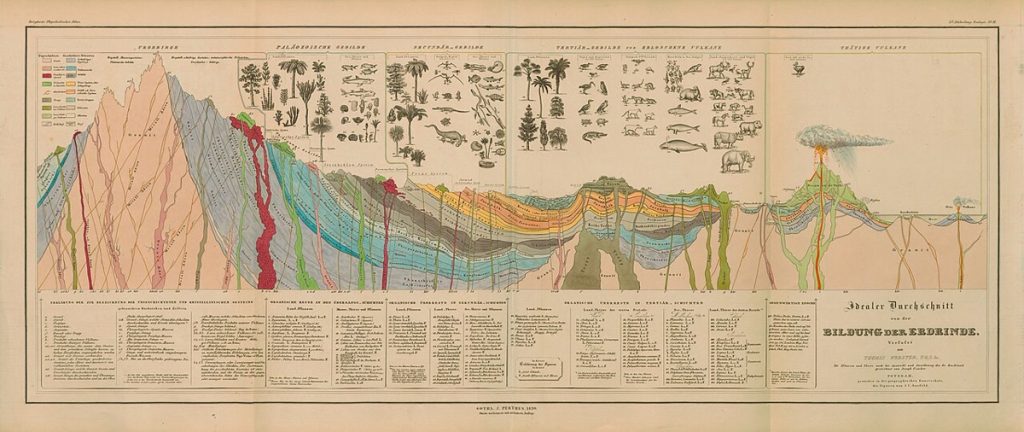
These earths crust facts start with the basics: the crust is the thin, rocky outer layer of our planet, and it makes up only a tiny fraction of Earth’s total volume. Compared with the whole planet it is like the skin on an apple, yet it is where we live, grow food, dig for minerals and feel earthquakes.
All figures below are approximate averages, since the crust varies from place to place and sources round their numbers differently.
Key takeaways
- Oceanic crust is thin, around 5 to 10 km, while continental crust averages roughly 30 to 50 km.
- Oxygen and silicon make up about three quarters of the crust by mass.
- Oceanic crust is dense basalt-rich rock, and continental crust is lighter and more varied.
- The crust, along with the uppermost mantle, forms the rigid tectonic plates.
- Oceanic crust is young and constantly recycled, but some continental rock is billions of years old.
What is the Earth’s crust?
Earth has several layers: the crust, the mantle, the outer core and the inner core. The crust is the outermost, solid layer. Below it lies the mantle, a thick region of hot rock that makes up most of the planet’s volume. The boundary between the crust and mantle is called the Mohorovičić discontinuity, usually shortened to the Moho, named after the Croatian seismologist who identified it from changes in the speed of earthquake waves.
The planet’s radius is about 6,371 kilometres, so even the thickest crust is a very thin shell. For a general introduction, see the Wikipedia article on the crust.
How thick is the crust?
Thickness varies a great deal:
- Oceanic crust: typically about 5 to 10 kilometres thick.
- Continental crust: on average roughly 30 to 50 kilometres, though it can be thinner at rifts and thicker beneath mountain ranges.
- Under big mountains: places such as the Himalayas and the Andes have crustal roots that can reach well beyond the continental average.
The deepest holes humans have drilled, such as the Kola Superdeep Borehole in Russia at around 12 kilometres, have barely scratched the surface of the continental crust, let alone the mantle.
What is the crust made of?
The crust is mostly made of silicate rocks, which means they contain silicon and oxygen bonded with other elements. By mass, the most abundant elements are approximately:
| Element | Approx. share of crust by mass |
|---|---|
| Oxygen | 46% |
| Silicon | 28% |
| Aluminium | 8% |
| Iron | 5% |
| Calcium | 4% |
| Sodium, potassium and magnesium | Roughly 2 to 3% each |
Figures differ slightly between sources. Importantly, most of that oxygen is not free gas. It is locked inside minerals such as quartz, feldspar and mica. Valuable metals like gold, copper and uranium make up tiny fractions of the crust, which is why mining them requires finding places where natural processes have concentrated them.
Oceanic crust versus continental crust
The two kinds of crust differ in age, density and composition.
Oceanic crust
Oceanic crust is formed at mid-ocean ridges, where magma rises and cools into new rock. It is dense and built mostly of basalt and similar dark volcanic rocks. It is also young: very little of the present ocean floor is older than about 200 million years, because older crust is pulled back into the mantle at subduction zones.
Continental crust
Continental crust is lighter and more complex, containing a wide mix of igneous, metamorphic and sedimentary rocks, with a lot of granite-like material. Because it is less dense, it floats higher on the mantle and is much harder to destroy. Some continental rocks are billions of years old, giving geologists a long record of Earth’s history.
| Feature | Oceanic | Continental |
|---|---|---|
| Typical thickness | 5 to 10 km | 30 to 50 km average |
| Main rock type | Basalt and related rock | Granite-like and mixed rock |
| Density | Higher | Lower |
| Age | Mostly younger than about 200 million years | Up to billions of years |
Plate tectonics and why the crust moves
The crust and the uppermost, rigid part of the mantle together form the lithosphere, which is broken into large tectonic plates. These slowly move, typically at a few centimetres a year, roughly the rate fingernails grow. Where plates collide, mountains rise and subduction zones form. Where they pull apart, new crust forms. Where they slide past one another, as at the San Andreas Fault, earthquakes occur.
This movement shapes volcanoes, earthquakes, ocean basins and mountain chains. Understanding it helps scientists assess hazards, locate resources and reconstruct the past, such as how continents once joined to form supercontinents.
How scientists study the crust
Because nobody can drill far enough to sample it directly, geologists rely on indirect methods. Seismic waves from earthquakes and controlled explosions travel at different speeds through different materials, so recording them across the planet reveals boundaries such as the Moho. Gravity and magnetic surveys show variations in rock density and composition, while rock samples from mountains, mines and the ocean floor give direct clues about what the crust contains and how old it is. Radiometric dating of minerals then pins down ages.
Why the crust matters to everyday life
- Soil and food: weathered crustal rock becomes the soil that grows crops.
- Resources: metals, stone, sand, coal, oil, gas and groundwater all come from the crust.
- Hazards: earthquakes, tsunamis and volcanic eruptions arise from crustal processes.
- Building and engineering: the geology beneath a site affects foundations, tunnels and dams.
If you are curious about other measurements in our solar neighbourhood, our guide to how far the Moon is from Earth gives distances in miles and kilometres. And as with many science topics, the most reliable way to check numbers is to look at the primary source, an approach we also recommend in our piece on finding reliable facts about a public figure’s age.
Frequently asked questions
How thick is the Earth’s crust on average?
It depends on the type. Oceanic crust averages around 5 to 10 km, and continental crust around 30 to 50 km.
What is the most common element in the crust?
Oxygen, at about 46 per cent by mass, mostly bound into silicate minerals.
Is the crust the same as the lithosphere?
No. The lithosphere includes the crust and the rigid uppermost part of the mantle.
Why is oceanic crust younger than continental crust?
Dense oceanic crust is recycled into the mantle at subduction zones, while lighter continental crust tends to stay at the surface.
Can we drill through the crust?
Not yet. The deepest boreholes reach only around 12 km, far less than the thickness of continental crust at most locations.
Conclusion
These earths crust facts show a thin but dynamic shell that shapes our world, from the ocean floors to the highest mountains. It is thin, varied and always moving, and its minerals, soils and hazards touch everyday life more than most people realise.
Key takeaways about earths crust facts
Here is a short summary of earths crust facts so you can find the main points quickly.
- These earths crust facts start with the basics: the crust is the thin, rocky outer layer of our planet, and it makes up only a tiny fraction of Earth's total volume.
- All figures below are approximate averages, since the crust varies from place to place and sources round their numbers differently.
- Earth has several layers: the crust, the mantle, the outer core and the inner core.
- The planet's radius is about 6,371 kilometres, so even the thickest crust is a very thin shell.
If you only remember one thing about earths crust facts, make it the practical steps covered in this guide.
Check official sources before acting on anything related to earths crust facts, because details can change over time.
Questions about earths crust facts are common, so it helps to compare more than one trustworthy source.
Use this page as a starting point for earths crust facts and come back to it when your situation changes.
Good decisions about earths crust facts come from checking the facts, comparing your options and taking your time.
Related reading:
- WorkSmart Michaels: How to Reach the Employee Portal
- Psilocybin Ovoid: What the Term Means and Key Safety Facts
For general background, you can look up earths crust facts on Wikipedia.