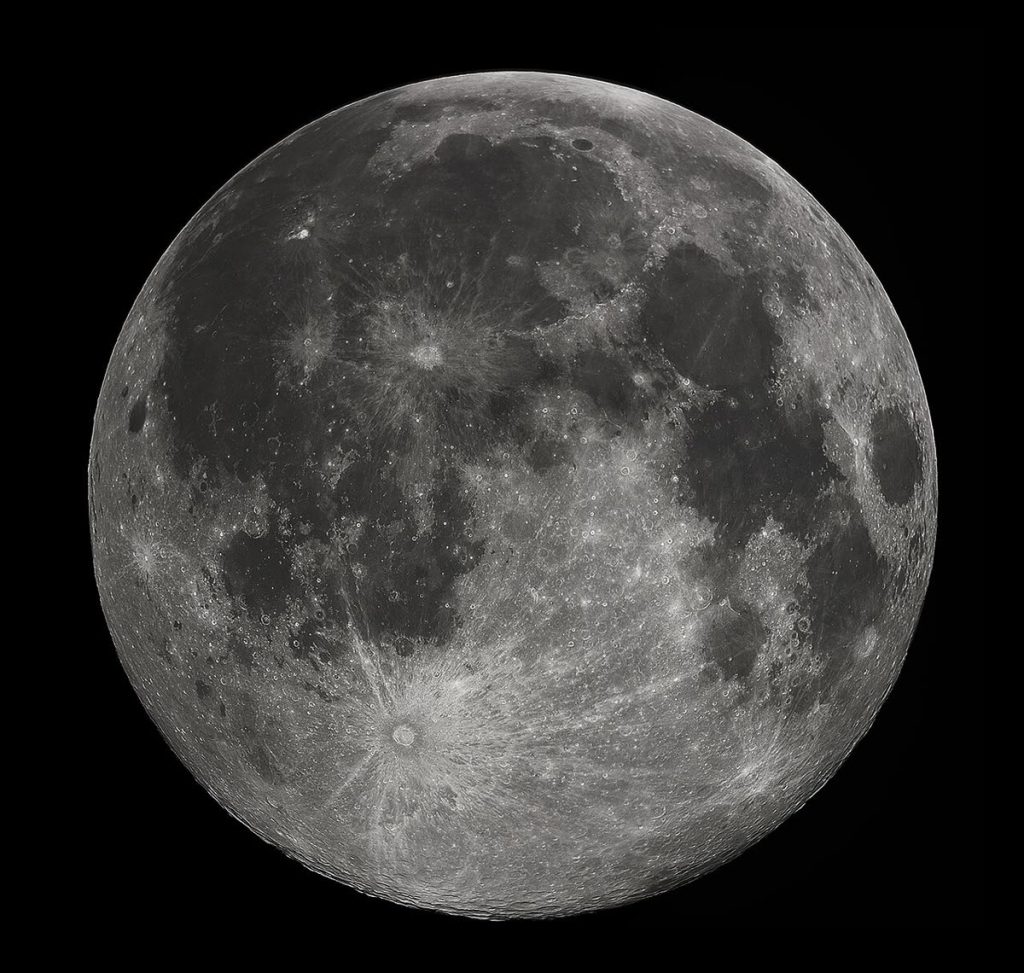
How far is the moon from earth? On average, about 384,400 kilometres, or 238,855 miles, measured from the centre of Earth to the centre of the Moon. That figure is only an average, because the Moon travels in an elliptical orbit, so the real distance changes by tens of thousands of kilometres over each month. This guide explains the closest and farthest points, how scientists measure the gap so precisely, and how long it takes to get there.
Key takeaways
- The average Earth-Moon distance is roughly 384,400 km (238,855 miles), centre to centre.
- The nearest point, perigee, is about 363,000 km and the farthest, apogee, about 405,000 km.
- The Moon is slowly moving away from Earth by a few centimetres every year.
- Laser ranging, using reflectors left by Apollo missions, measures the distance to within millimetres.
The average distance in miles and kilometres
The number most often quoted is 384,400 km, which is about 238,855 miles. It is the mean distance between the centres of the two bodies. If you measured from the surface of Earth to the surface of the Moon instead, the gap would be smaller, by roughly the radius of each: about 6,371 km for Earth and 1,737 km for the Moon. The surface-to-surface figure is therefore around 376,000 km on average.
To picture the size of that, Earth’s diameter is about 12,742 km, so the Moon sits at roughly thirty Earth-widths away. It is far enough that the Moon looks small in the sky, yet close enough to be the only other world humans have visited. You can read the wider background on the Moon Wikipedia page.
Closest and farthest: perigee and apogee
The Moon’s orbit is not a perfect circle. It is a slightly stretched ellipse, with Earth sitting off-centre. That produces two extremes every orbit, which lasts about 27 days.
| Point | Name | Approx. distance (km) | Approx. distance (miles) |
|---|---|---|---|
| Closest | Perigee | 363,000 | 226,000 |
| Average | Mean distance | 384,400 | 238,855 |
| Farthest | Apogee | 405,000 | 252,000 |
The exact perigee and apogee values vary from orbit to orbit, because the Sun’s gravity tugs on the Moon’s path. Typical extremes are in the ranges above, but astronomers publish precise figures for each month in almanacs and observatory tables.
What is a supermoon?
When a full Moon happens close to perigee, it is popularly called a supermoon. It can look slightly larger and brighter than usual, though the difference is subtle and hard to notice without comparing photographs. A full Moon near apogee is sometimes called a micromoon. These names are informal rather than strict scientific terms.
Is the Moon moving away from Earth?
Yes, but slowly. Tidal interactions between Earth and the Moon transfer energy from Earth’s rotation to the Moon’s orbit. The result is that the Moon drifts away at about 3.8 centimetres a year, which is often compared with the rate at which fingernails grow. Over a human lifetime this is just a few metres, tiny against the total distance, but over hundreds of millions of years it adds up. The same process is gradually slowing Earth’s rotation, making days very slightly longer over geological time.
How do scientists measure the distance?
Early estimates came from geometry. Astronomers observed the Moon from two distant places at once and used the shift in its apparent position, known as parallax, to calculate the gap. Modern measurements are far more accurate and use lasers.
During the Apollo missions between 1969 and 1972, astronauts placed retroreflector arrays on the lunar surface, and Soviet robotic missions delivered further ones. Observatories on Earth fire short laser pulses towards these reflectors and time how long the light takes to return. Since light travels at about 299,792 km per second, the round trip takes roughly 2.5 seconds, and the timing can be turned into a distance with millimetre-level precision. This technique, called lunar laser ranging, is also used to test aspects of gravity physics.
How long does it take to travel to the Moon?
The travel time depends on the speed and the route.
- Light or radio signals: about 1.3 seconds one way, which causes the noticeable delay in communications with lunar missions.
- Apollo missions: around three days to reach lunar orbit.
- A car at 70 mph: roughly 142 days of nonstop driving, if a road existed, based on the average distance.
- A passenger jet at about 560 mph: around 18 days of continuous flight.
These are simple calculations for comparison. Real spacecraft do not travel in straight lines, and they must slow down to enter orbit, so mission durations vary with the trajectory and the mission design.
Fun comparisons that help you picture it
The Moon’s distance is large but still modest in space terms. Light from the Sun takes about eight minutes to reach us, while moonlight is reflected sunlight that travels the extra 1.3 seconds from the Moon. Another popular comparison suggests that you could fit all the other planets of the Solar System, lined up, in the space between Earth and the Moon. The result depends on the numbers you pick for planetary diameters, and the squeeze is tight, but it makes a memorable point about how much emptiness lies between worlds.
If distances in the Solar System interest you, our guide to Mercury’s distance from the Sun covers similar ground, and our explainer on Earth’s crust looks at the planet beneath our feet.
Why the distance matters on Earth
The Moon’s gravity drives the ocean tides. When the Moon is closer to perigee, tidal forces are slightly stronger, which can produce higher high tides, known as perigean spring tides, especially if combined with new or full Moon alignments. Coastal forecasters take this into account along with weather. For anyone planning to visit the seaside or photograph a rising Moon, official tide tables and local forecasts remain the best sources.
The distance also affects eclipses. If the Moon is near apogee during a solar eclipse, it appears slightly too small to cover the Sun completely, producing a ring-shaped annular eclipse instead of a total one. If you want to check the date or figures for any specific future event, use an observatory or space agency source such as NASA, since exact data for a given date depends on current orbital calculations.
Frequently asked questions
How far is the Moon in miles?
The average is about 238,855 miles. At its closest it is about 226,000 miles away, and at its farthest about 252,000 miles.
How many Earths fit between Earth and the Moon?
Roughly thirty Earth diameters fit in the average gap, since Earth is about 12,742 km wide and the distance is about 384,400 km.
Why does the distance change?
The Moon follows an elliptical orbit, and the Sun’s gravity also perturbs its path, so the distance varies from orbit to orbit.
Is the Moon getting farther away?
Yes, by about 3.8 cm each year, because of tidal interaction with Earth.
How long does light take to reach the Moon?
About 1.3 seconds each way, so a laser pulse sent to the Moon and back takes around 2.5 seconds.
Conclusion
So, how far is the moon from earth? About 384,400 km on average, ranging from roughly 363,000 km at perigee to 405,000 km at apogee, and growing by a few centimetres every year. For exact figures on a particular date, check an observatory or space agency table.
Key takeaways about how far is the moon from earth
Here is a short summary of how far is the moon from earth so you can find the main points quickly.
- The number most often quoted is 384,400 km, which is about 238,855 miles.
- To picture the size of that, Earth's diameter is about 12,742 km, so the Moon sits at roughly thirty Earth-widths away.
- The Moon's orbit is not a perfect circle.
- The exact perigee and apogee values vary from orbit to orbit, because the Sun's gravity tugs on the Moon's path.
Use this page as a starting point for how far is the moon from earth and come back to it when your situation changes.
Good decisions about how far is the moon from earth come from checking the facts, comparing your options and taking your time.
Save this guide to how far is the moon from earth so you can find it again whenever you need a quick reminder.
If you only remember one thing about how far is the moon from earth, make it the practical steps covered in this guide.
Check official sources before acting on anything related to how far is the moon from earth, because details can change over time.
Questions about how far is the moon from earth are common, so it helps to compare more than one trustworthy source.
Related reading:
- Bundt Pan Meaning: What It Is and How to Bake in One
- Radicand Definition: What It Is in Maths, With Examples
For general background, you can look up how far is the moon from earth on Wikipedia.