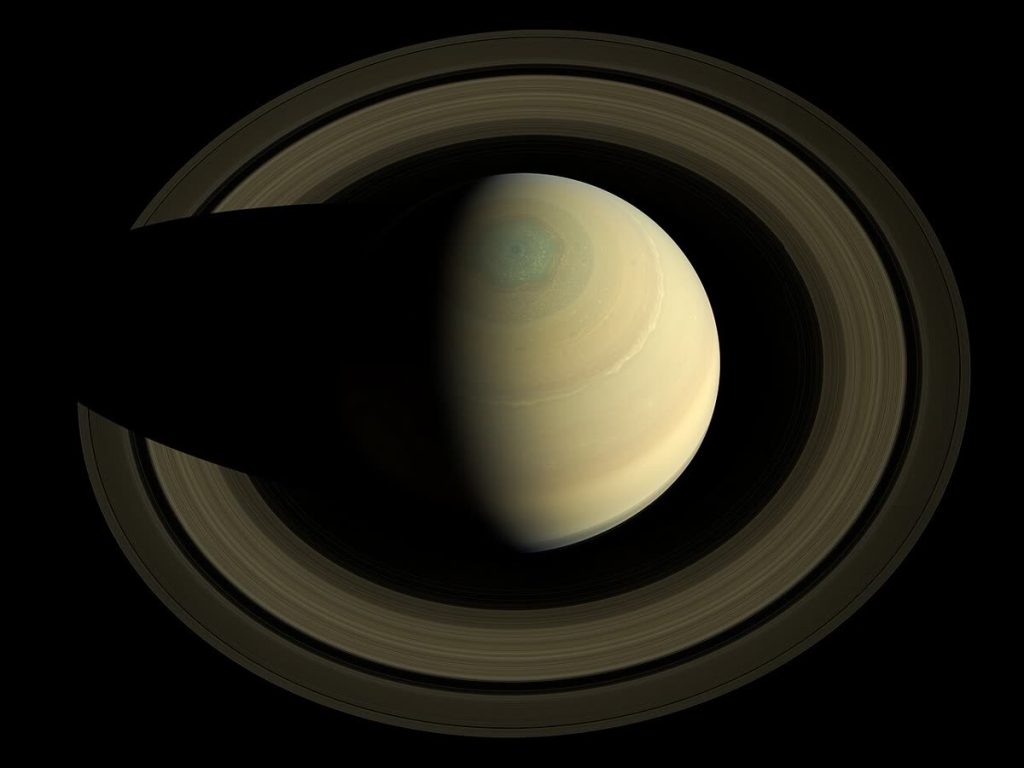
Here is the distance from sun Saturn keeps on average: about 1.43 billion kilometres, or roughly 886 million miles, which is around 9.5 times farther out than Earth. Because Saturn’s orbit is slightly oval, the figure changes through its 29-year journey around the Sun. Below you will find the exact ranges, how long sunlight takes to arrive, how Saturn compares with other planets, and ways to picture such huge numbers.
Key takeaways
- Saturn’s average distance from the Sun is about 1.43 billion km (886 million miles), or about 9.5 astronomical units.
- Sunlight takes roughly 80 minutes to reach Saturn, compared with about 8 minutes for Earth.
- Its distance varies from around 9.0 to 10.1 AU because the orbit is elliptical.
- One Saturn year lasts about 29.4 Earth years.
Distance from sun Saturn in miles, km and AU
Astronomers measure the Solar System in astronomical units. One AU is the average Earth-Sun distance, about 149.6 million kilometres or 93 million miles. Saturn orbits at about 9.5 AU on average, which converts to the figures below. Values are rounded, and agencies such as NASA publish detailed planetary fact sheets if you need more precision.
| Measure | Closest (perihelion) | Average | Farthest (aphelion) |
|---|---|---|---|
| Astronomical units | about 9.0 | about 9.5 | about 10.1 |
| Kilometres | about 1.35 billion | about 1.43 billion | about 1.51 billion |
| Miles | about 840 million | about 886 million | about 940 million |
How long does sunlight take to reach Saturn?
Light travels at about 300,000 kilometres per second. At Saturn’s average distance, a beam from the Sun needs about 79 to 80 minutes to arrive. At closest approach it takes around 75 minutes, and at the farthest point around 84 minutes. By comparison, sunlight reaches Earth in about 8 minutes and 20 seconds. This is also why the Sun appears much dimmer from Saturn: the sunlight there is only about one percent as intense as at Earth.
Why does the distance change?
Planets follow elliptical orbits described by Kepler’s laws. Saturn’s orbit is mildly elongated, with an eccentricity of about 0.05, which is why its distance varies by roughly 150 million kilometres between its nearest and farthest points. The planet also moves faster when closer to the Sun and slower when farther away. A full orbit takes about 29.4 Earth years, so a person who is 30 would have lived through just over one Saturn year.
Distance from Earth to Saturn
People often confuse the Sun-Saturn distance with the Earth-Saturn distance. Because both planets move, the gap between them changes much more. At their closest, Earth and Saturn are about 1.2 billion kilometres apart, and at the farthest, when Saturn is on the opposite side of the Sun, around 1.66 billion kilometres. A radio signal to a spacecraft there can take between roughly 68 and 84 minutes one way.
How Saturn compares with other planets
| Planet | Average distance from Sun (AU) | Orbit length |
|---|---|---|
| Mercury | 0.39 | 88 days |
| Venus | 0.72 | 225 days |
| Earth | 1.00 | 365 days |
| Mars | 1.52 | 687 days |
| Jupiter | 5.2 | 11.9 years |
| Saturn | 9.5 | 29.4 years |
| Uranus | 19.2 | 84 years |
| Neptune | 30.1 | 165 years |
Saturn is the sixth planet from the Sun and the second largest, after Jupiter. It is known for its spectacular ring system, a collection of ice and rock particles. You can read more about the planet on Wikipedia.
Ways to picture the distance
A scale model you can build
Let one metre represent one AU. The Sun would be a tiny speck, Earth would sit one metre away, and Saturn would be about 9.5 metres from the centre. You could pace this out in a garden or a school hall. Neptune would stand 30 metres away.
Travel time
A car at 100 km/h would need over 1,600 years to reach Saturn from the Sun, ignoring practical problems. Spacecraft are much faster. The Cassini mission, launched in 1997, took nearly seven years to reach Saturn in 2004, using gravity assists from other planets to save fuel.
Temperature
Because it is so far from the Sun, Saturn’s upper atmosphere is extremely cold, with cloud-top temperatures far below freezing. The planet is a gas giant with no solid surface to stand on.
Other fun facts for science lovers
- Saturn’s average density is lower than water, so in a hypothetical giant bath it would float.
- The ring system is wide but extremely thin in places, only tens of metres thick in some sections.
- Saturn has dozens of confirmed moons, including Titan, which has a dense atmosphere.
If you enjoy cold places on our own planet, you might like to read whether there really are polar bears at the South Pole or compare the summer temperatures in New Zealand. For students working on geometry, see the formula for a semicircle, useful when sketching orbits.
Why Saturn’s distance matters for missions
The huge distance shapes everything about exploring Saturn. Sunlight is so weak that spacecraft there cannot rely on ordinary solar panels at the scale used near Earth, so missions such as Cassini used radioisotope power sources. Communication delays mean controllers cannot steer a probe in real time; instructions are sent in advance and executed automatically. And flight paths are planned years ahead, using gravity assists from Venus, Earth and Jupiter to gain speed.
Light-travel time in practice
Because radio waves travel at light speed, a command from Earth might take over an hour to reach a spacecraft in orbit around Saturn, and the confirmation takes as long to return. That delay is why autonomy is built into every deep-space probe.
Frequently asked questions
How far is Saturn from the Sun in miles?
On average about 886 million miles, varying from roughly 840 million to 940 million miles.
How many AU is Saturn from the Sun?
About 9.5 AU on average, with a range of around 9.0 to 10.1 AU.
How long does light from the Sun take to reach Saturn?
About 80 minutes at the average distance.
How long is a year on Saturn?
About 29.4 Earth years.
Is Saturn the farthest planet?
No. Uranus and Neptune are farther away from the Sun.
Conclusion
The distance from sun Saturn orbits, roughly 1.43 billion kilometres, shows how vast the Solar System is. Remember the 9.5 AU rule of thumb and the 80-minute light travel time, and you will have the key facts at your fingertips.
Key takeaways about distance from sun saturn
Here is a short summary of distance from sun saturn so you can find the main points quickly.
- Here is the distance from sun Saturn keeps on average: about 1.43 billion kilometres, or roughly 886 million miles, which is around 9.5 times farther out than Earth.
- Astronomers measure the Solar System in astronomical units.
- Planets follow elliptical orbits described by Kepler's laws.
- People often confuse the Sun-Saturn distance with the Earth-Saturn distance.
Check official sources before acting on anything related to distance from sun saturn, because details can change over time.
Questions about distance from sun saturn are common, so it helps to compare more than one trustworthy source.
Related reading:
- Power Outage Chantilly VA: Check, Report and Prepare
- Drawing of Mass in Science: How to Draw a Mass Spectrum
For general background, you can look up distance from sun saturn on Wikipedia.