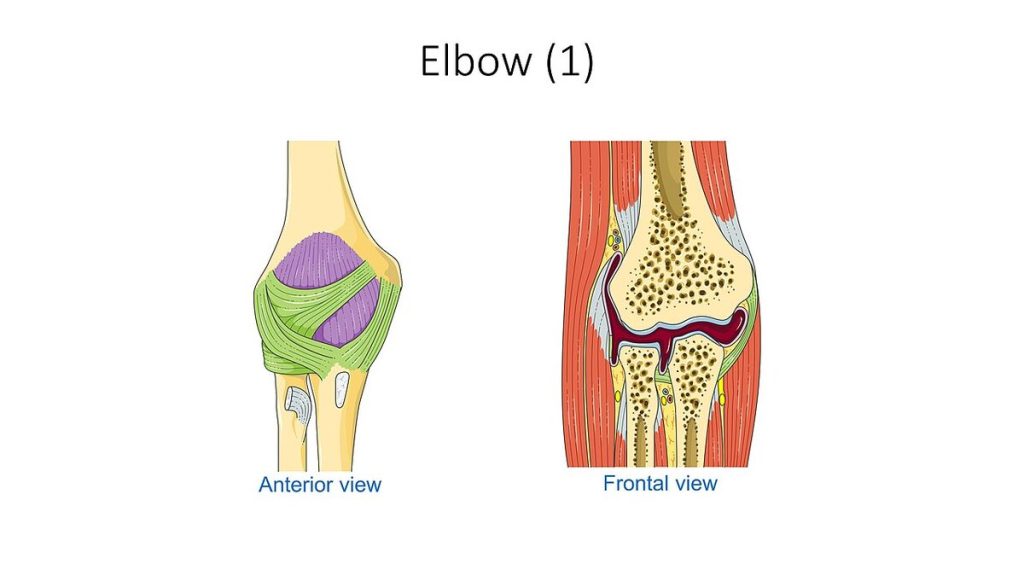
The elbow bone name you are probably looking for depends on which part of the joint you mean, because the elbow is where three bones meet: the humerus in the upper arm, and the ulna and radius in the forearm. The bony point you can feel at the back of your elbow is part of the ulna, called the olecranon. Knowing which bone is which makes it far easier to understand injuries, scans and exercises.
Key takeaways
- Three bones form the elbow joint: the humerus, the ulna and the radius.
- The pointy bit at the back of the elbow is the olecranon, part of the ulna.
- The humerus ends in rounded and bony landmarks, including the medial and lateral epicondyles, which you can feel on either side.
- For pain, swelling or a suspected fracture, see a doctor or urgent care service rather than relying on an article.
The elbow bone name at a glance
The elbow is a hinge-type joint that allows you to bend and straighten your arm, plus a pivot-type movement that lets the forearm rotate. Three bones come together here, and each has its own role.
| Bone | Location | Role in the elbow |
|---|---|---|
| — | — | — |
| Humerus | Upper arm | Forms the top of the joint with rounded and bony ends |
| Ulna | Forearm, little-finger side | Hinges with the humerus; its olecranon forms the point of the elbow |
| Radius | Forearm, thumb side | Rotates around the ulna and meets the humerus at the head of the radius |
You can think of it as one long bone above and two bones below, with a set of ligaments, cartilage and tendons holding everything together.
The humerus: the upper arm bone
The humerus is the long bone running from the shoulder to the elbow. At its lower end it widens and has several named features that matter for the elbow.
- **Trochlea**: a spool-shaped surface that fits with the ulna, allowing the hinge movement.
- **Capitulum**: a rounded knob on the outer side that meets the head of the radius.
- **Medial epicondyle**: the bony bump on the inner side of the elbow, commonly known as the funny bone area because the ulnar nerve passes behind it.
- **Lateral epicondyle**: the bump on the outer side where many forearm muscles attach.
- **Olecranon fossa**: a hollow at the back where the point of the ulna sits when the arm is straight.
The two epicondyles are well known in sport medicine. Irritation of the tendons attached at the outer side is often called tennis elbow, while irritation at the inner side is often called golfer’s elbow.
The ulna: home of the olecranon
The ulna is the longer of the two forearm bones on the little-finger side. At the top it has a hook-like shape. The olecranon is the large bony prominence at the back, and the coronoid process sits at the front. Together they grip the trochlea of the humerus like a wrench around a bolt, which gives the elbow its stable hinge.
If you rest your elbow on a table, the olecranon is the part taking the pressure. It is protected by a small fluid-filled sac called a bursa, which can become inflamed and swollen, a condition known as olecranon bursitis.
The radius: the rotating forearm bone
The radius runs along the thumb side of the forearm. Its upper end is a disc-shaped head that sits against the capitulum of the humerus and rotates within a ring of ligament. This allows you to turn the palm up (supination) and palm down (pronation). Because the radius pivots around the ulna, the joint between them near the elbow is called the proximal radioulnar joint.
How the joint works
The elbow is really three connected joints within one capsule.
- The humeroulnar joint, between the humerus and ulna, creates the main hinge for bending and straightening.
- The humeroradial joint, between the humerus and radius, helps with bending and with rotating.
- The proximal radioulnar joint, between the radius and ulna, allows the forearm to rotate.
Ligaments on each side, the ulnar collateral ligament and the radial collateral ligament, prevent the joint from sliding sideways. Strong muscles, including the biceps at the front and the triceps at the back, drive the movement.
Common injuries involving the elbow bones
Knowing the elbow bone name for each part helps you understand what a doctor or physiotherapist says.
Fractures
A fall onto an outstretched hand or a direct blow can break the olecranon, the head of the radius or the lower humerus. In children, injuries around the humerus above the elbow are particularly common. Signs include severe pain, swelling, deformity, bruising and inability to move the arm. Treat this as urgent and seek medical care.
Dislocation
The ulna and radius can be forced out of position relative to the humerus, usually after a fall. It needs prompt medical attention.
Tendon and nerve problems
Tennis elbow, golfer’s elbow and ulnar nerve irritation are common overuse problems. Rest, load management and exercises prescribed by a physiotherapist often help. Read the NHS page on tennis elbow for general self-care advice.
If you are in any doubt after an injury, especially if the arm looks misshapen, you cannot straighten it, or there is numbness, get checked promptly. This article is general information and not a substitute for medical advice.
Easy ways to remember the bones
- Humerus: the “funny bone” nickname comes from the humerus area where the ulnar nerve passes, not from the bone itself.
- Ulna: think of “U” for the elbow Underside, where it forms the tip, or link it to the little finger side.
- Radius: the radius rotates, and it is on the thumb side.
A simple self-check is to bend your arm and feel the point of the olecranon at the back, then feel the bumps either side of the joint, which are the epicondyles of the humerus.
If you are curious about how other parts of anatomy and science are explained step by step, see our guides on how many teeth kids have, the stages of cauliflower ear and second-class levers, which helps explain how muscles and bones work as levers. For a fuller reference on the joint, the Wikipedia article on the elbow is a reasonable start.
Frequently asked questions
What is the elbow bone name for the pointy part?
The pointy part at the back is the olecranon, which is part of the ulna.
How many bones are in the elbow?
Three bones form the joint: the humerus, the ulna and the radius.
What is the funny bone?
The funny bone is not a bone. It is the spot at the inner elbow where the ulnar nerve passes close to the surface behind the medial epicondyle of the humerus, so a knock there causes tingling.
Is the elbow a hinge joint?
Largely yes. The humeroulnar joint works as a hinge, while the radius adds rotation, so the elbow combines hinge and pivot movements.
When should I see a doctor for elbow pain?
See a professional if you have severe pain after a fall, visible deformity, numbness, an inability to move the arm, fever with a hot swollen elbow, or pain that persists for more than a couple of weeks.
Conclusion
The elbow bone name depends on the part you mean: humerus above, ulna and radius below, with the olecranon forming the point you can feel. Once you can picture these three bones and how they meet, injury terms and medical scans become much easier to follow.
Key takeaways about elbow bone name
Here is a short summary of elbow bone name so you can find the main points quickly.
- The elbow bone name you are probably looking for depends on which part of the joint you mean, because the elbow is where three bones meet: the humerus in the upper arm, and the ulna and radius in the forearm.
- The elbow is a hinge-type joint that allows you to bend and straighten your arm, plus a pivot-type movement that lets the forearm rotate.
- You can think of it as one long bone above and two bones below, with a set of ligaments, cartilage and tendons holding everything together.
- The humerus is the long bone running from the shoulder to the elbow.
Save this guide to elbow bone name so you can find it again whenever you need a quick reminder.
If you only remember one thing about elbow bone name, make it the practical steps covered in this guide.
Check official sources before acting on anything related to elbow bone name, because details can change over time.
Related reading:
- Where Do Kernels Come From? Popcorn, Corn and Seeds
- Food Stamps in Oklahoma Income Guidelines: How They Work
For general background, you can look up elbow bone name on Wikipedia.