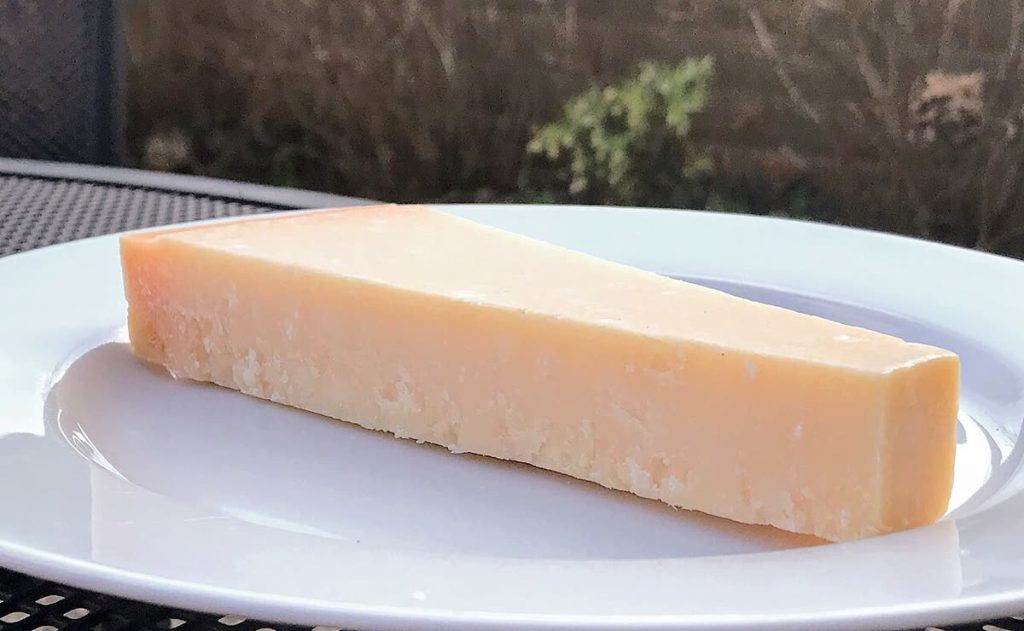
A parmesan rind is the hard, dry outer edge of a wedge of Parmesan, and instead of binning it you can simmer it in soups, sauces, beans and stocks to add a deep, nutty, savoury flavour. It will not soften enough to eat while raw, but in hot liquid it releases the same umami richness as the cheese itself, giving you a free flavour booster.
Key takeaways
- A genuine Parmigiano Reggiano rind is edible cheese, not wax or plastic, but check labels on supermarket wedges.
- Store rinds in the freezer so you always have one ready.
- Simmer for 30 to 60 minutes in soups, sauces, stocks and bean dishes, then remove.
- Scrape off any labels or ink before cooking.
What a Parmesan rind is
As a wheel of Parmesan ages, the outside dries and toughens into a rind that protects the cheese inside. In traditional Parmigiano Reggiano, the rind forms from the cheese itself, and the wheel is stamped with its markings on the outside. It is simply an older, denser, drier layer of the same cheese, so it carries the same savoury, glutamate-rich flavour. The Consortium that protects the cheese explains its production at parmigianoreggiano.com, and Wikipedia has a good background article.
Is every rind safe to cook with?
No, so check before you buy and before you simmer. Some pre-cut or grated-style products use a coating, wax or plastic wrap on the outside, and some imitation “Parmesan-style” cheeses have rinds with additives. A rind should be firm, pale and look like hard cheese. If it feels waxy, glossy or has a visible coating, or the label mentions plastic or wax, leave it out of the pot. When in doubt, ask the person at the cheese counter or read the packaging.
How to save and store rinds
- When you finish a wedge, cut off the rind, leaving a few millimetres of cheese attached if you like.
- Wipe it with a clean cloth and scrape away any printed lettering or labels.
- Wrap it in baking parchment or put it in a small freezer bag or lidded container.
- Freeze it. A rind keeps for many months, and you can add it directly from frozen.
- Label the bag with the date so you use older rinds first.
Keeping a few rinds in a bag means you never have to plan ahead for a soup or sauce.
Ways to cook with a parmesan rind
| Dish | How to use the rind | Approximate time |
|---|---|---|
| Minestrone or vegetable soup | Drop in whole with the stock | 45 to 60 minutes of simmering |
| Tomato sauce | Simmer gently in the sauce | 30 to 60 minutes |
| Beans and lentils | Add at the start with aromatics | Until the beans are tender |
| Risotto | Place in the pot while the stock is added | Removed before serving |
| Polenta | Simmer in the water or stock | Throughout cooking |
| Homemade stock | Add with vegetables | 1 to 2 hours |
Pasta fans can add one to a pot of ragù, or serve it alongside a baked pasta. If you bake dishes such as lasagna, take a look at what temperature and how long to bake lasagna, since a rind-enriched sauce works well in the layers.
Step by step: simmering the rind in soup
- Sweat onion, carrot and celery in olive oil until soft.
- Add garlic, tomatoes or tomato paste, then your liquid (stock or water).
- Drop in the rind and bring to a gentle simmer, never a hard boil.
- Add beans, pasta or vegetables according to your recipe.
- After the rind has softened and the broth tastes rich, fish it out.
- Taste and adjust salt. The rind adds saltiness, so go lightly with seasoning early on.
What happens to the rind after cooking?
It turns soft, chewy and a bit gooey, and the cheese may partly melt into the liquid. Some cooks cut the softened rind into small pieces and eat it, treating it as a savoury treat. Others discard it. If the rind is still very tough, it can go back in the pot or into the bin. You can also pull the rind out, rinse it and freeze it again for one more round, though flavour weakens each time.
Sharpen the flavour
A splash of acid at the end, such as lemon juice or a little vinegar, balances the richness. A grating of fresh Parmesan on top gives a fresh contrast to the mellow, melted depth of the rind. For soft greens and brothy pastas, the same trick pairs well with the idea behind cooking pasta al dente, which keeps texture lively against a creamy broth.
Other uses
- Grill a clean rind over embers or a hot pan until blistered and chewy as a snack.
- Infuse milk or cream for a savoury sauce, strain and use for creamy pasta or mashed potatoes.
- Tuck a rind into a jar of olive oil for a few days to infuse it, and use the oil for dipping.
- Place a piece in a pot of cooking polenta or grits to enrich them.
Common questions about flavour and texture
Why does a rind taste so strong? Ageing concentrates flavour, and the outer layer loses the most moisture, so its salt and glutamates are packed into a smaller space. This is the same reason aged Parmesan is more intense than a younger wheel. When you simmer the rind, those compounds dissolve into the liquid, which is why a plain vegetable broth can suddenly taste meaty without any meat.
How much salt do you need? Less than usual. A rind brings its own saltiness, so wait until the dish has simmered and taste it before adding more. If you overshoot, a peeled potato or a squeeze of lemon helps soften the effect, and extra unsalted stock rebalances the pot.
Vegetarian note
Traditional Parmigiano Reggiano is made with animal rennet, so it is not vegetarian. If that matters, look for hard Italian-style cheeses labelled as made with vegetarian rennet before keeping their rinds for cooking.
Frequently asked questions
Can you eat a Parmesan rind?
Yes, if it is a genuine cheese rind. It is very hard raw, but it softens when cooked in liquid and can be eaten, though many people prefer to remove it.
How long should I cook a Parmesan rind?
Thirty to sixty minutes in a simmering soup or sauce is typical, and longer in stocks. More time gives more flavour, as long as it stays at a gentle simmer.
Can I freeze Parmesan rinds?
Yes. Wrap them well or use a freezer bag, and add them straight from the freezer into the pot.
Does the rind melt?
It softens and partly melts but does not disappear completely. Remove it before serving unless you plan to eat it.
Is the rind of other cheeses usable in the same way?
Some hard cheeses such as Pecorino or Grana Padano have edible rinds that also work in cooking. Soft cheeses and waxed cheeses do not. Always check the cheese’s labelling.
Conclusion
A parmesan rind is a small piece of kitchen thrift with a big flavour payoff. Keep rinds in the freezer, check they are real cheese rather than wax, and simmer them into soups, sauces and beans for richer, rounder results.
Key takeaways about parmesan rind
Here is a short summary of parmesan rind so you can find the main points quickly.
- A parmesan rind is the hard, dry outer edge of a wedge of Parmesan, and instead of binning it you can simmer it in soups, sauces, beans and stocks to add a deep, nutty, savoury flavour.
- As a wheel of Parmesan ages, the outside dries and toughens into a rind that protects the cheese inside.
- No, so check before you buy and before you simmer.
- Keeping a few rinds in a bag means you never have to plan ahead for a soup or sauce.
Good decisions about parmesan rind come from checking the facts, comparing your options and taking your time.
Related reading:
- Buried or Embedded Tick on Dog: What to Do and When to Call
- What Is White Fish? Types, Taste, Nutrition and How to Cook It
For general background, you can look up parmesan rind on Wikipedia.