Why is salt put on icy roads? Because salt dissolves into the thin film of water on the surface and lowers the temperature at which that water freezes, so ice melts or never forms in the first place. Pure water freezes at 0°C (32°F), but salty water has to get colder before it turns solid. Road crews use that gap to keep traffic moving, though salt has limits, costs and side effects that are worth understanding.
Key takeaways
- Salt works through freezing point depression: dissolved salt makes it harder for water to form ice.
- It is most effective at temperatures just below freezing and loses power as it gets much colder.
- Spreading it before a freeze (pre-treating) is often more effective than clearing ice afterwards.
- Salt can corrode vehicles and harm plants and waterways, so authorities balance it against alternatives.
The science in plain terms
The effect is called freezing point depression. When salt, which is sodium chloride, dissolves in water, it splits into sodium and chloride ions. These get in the way of water molecules trying to arrange themselves into the ordered crystal structure of ice. The more salt that is dissolved, the lower the freezing point falls.
Ice is never perfectly dry. A very thin layer of liquid water exists on its surface, even below freezing. Salt dissolves into that layer and makes brine, and the brine then melts more of the ice around it, creating more liquid to dissolve more salt. Traffic helps by mixing and spreading the brine across the carriageway. The process needs some moisture and a little time, which is why a dry dusting of salt on a very cold, dry road does much less than you would expect.
How cold can salt work?
A pure salt-and-water mixture can in theory stay liquid down to about -21°C (-6°F), but real roads do not behave like laboratory beakers. In practice, rock salt is dependable at temperatures just below freezing and becomes slow and less effective as it gets colder. Highway authorities often quote a working range of roughly -5 to -10°C, depending on conditions, the amount applied and how much traffic keeps it moving. When temperatures plunge further, the melting action slows to a crawl.
That is why on very cold nights, authorities may use different products or mix in other materials, and why sand or grit is sometimes spread to provide traction rather than to melt ice.
Why salt is the usual choice
Rock salt is cheap, widely available, easy to store and simple to spread with specialised vehicles. For most winter conditions it is the most cost-effective option for councils and highway agencies. Large stockpiles are kept in salt barns ahead of winter so that crews can respond quickly. You can read an overview of the practice on Wikipedia’s road salt page.
In the UK, national and local authorities publish winter service plans, and National Highways explains its approach to gritting on its official website. In the United States, state departments of transportation do the same, and policies vary from place to place.
Pre-treating versus clearing afterwards
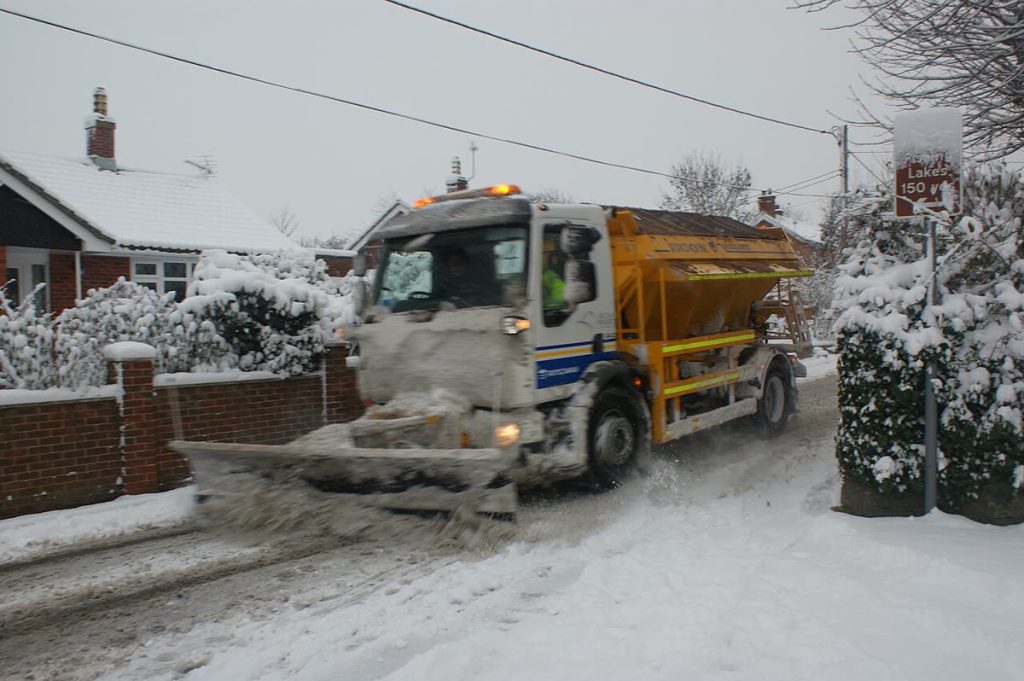
Crews often apply salt or a salt brine before a storm. This stops ice bonding firmly to the road surface, which makes it much easier to plough or clear later. Treating after ice has formed still works, but it uses more material and takes longer. This is why you may see roads being gritted in dry weather when the forecast suggests a freeze overnight.
Where salt falls short
- Very low temperatures: below about -10°C the melting effect is weak.
- Heavy snow: salt cannot keep up with fast, deep accumulations; ploughing is needed.
- Rain washing it away: heavy rain after treatment can dilute and remove the salt before a freeze.
- Light traffic: without vehicles to mix it in, salt on quiet roads can take longer to act.
- Black ice: thin, nearly invisible ice can form quickly on bridges and shaded stretches, even on treated roads.
Alternatives to ordinary rock salt
| Material | How it helps | Drawbacks |
|---|---|---|
| Salt brine | Pre-treatment spray | Needs equipment; same environmental concerns |
| Calcium chloride | Works at lower temperatures | More expensive; can be corrosive |
| Magnesium chloride | Effective in the cold | Cost; some environmental concerns |
| Sand or grit | Adds traction | Does not melt ice; can clog drains |
| Beet-juice blends | Lowers the freezing point and helps salt stick | Cost and availability |
Each option involves a trade-off between cost, performance and environmental impact. Many authorities use a combination, matching the product to the forecast.
Environmental and practical downsides
Salt is not harmless. It speeds up corrosion of vehicles, bridges and street furniture. Runoff can reach rivers, lakes and groundwater, raising salinity, and it can damage roadside plants and soil. Pets can suffer from irritated paws. Because of this, managers try to use only as much as is needed, and many places refine their spreading with weather sensors and calibrated spreaders.
At home, you can reduce your own impact by clearing snow first, using only a small amount of salt on paths and steps, and choosing sand or pet-safe products where appropriate. Rinse your car’s underside after salty journeys.
A similar everyday curiosity
Salt on icy roads is one of those everyday science puzzles that sounds more mysterious than it is. If you enjoy simple explanations of why things work, you may like our pieces on why the determinant of an identity matrix always equals 1 and why some people crave cornstarch.
Frequently asked questions
Why is salt put on icy roads instead of just using heat?
Heating roads is expensive and impractical at scale. Salt is cheap, spreadable and works passively through chemistry once it meets moisture.
Does salt melt ice at any temperature?
No. It works best near freezing and becomes much less effective in deep cold. Its theoretical limit is around -21°C, but in practice it is slower well before that.
Why do roads get gritted before snow falls?
Pre-treatment stops ice and packed snow bonding to the surface, which makes removal easier and helps keep traffic moving.
Is road salt bad for cars?
It can speed up corrosion, particularly on exposed metal and the underside. Washing your vehicle in winter, including underneath, helps.
Are there greener alternatives?
Brine, blended products and better targeting reduce the amount of salt used, and sand improves grip. Each has trade-offs, so authorities usually combine methods.
Conclusion
So, why is salt put on icy roads? Because dissolved salt lowers the freezing point of water, helping ice melt or stop forming, at low cost and with simple equipment. It has limits in deep cold and a real environmental price, which is why timing, the right amount and alternatives all matter.
Key takeaways about why is salt put on icy roads
Here is a short summary of why is salt put on icy roads so you can find the main points quickly.
- A pure salt-and-water mixture can in theory stay liquid down to about -21°C (-6°F), but real roads do not behave like laboratory beakers.
- That is why on very cold nights, authorities may use different products or mix in other materials, and why sand or grit is sometimes spread to provide traction rather than to melt ice.
- Rock salt is cheap, widely available, easy to store and simple to spread with specialised vehicles.
- In the UK, national and local authorities publish winter service plans, and National Highways explains its approach to gritting on its official website.
Check official sources before acting on anything related to why is salt put on icy roads, because details can change over time.
Questions about why is salt put on icy roads are common, so it helps to compare more than one trustworthy source.
Use this page as a starting point for why is salt put on icy roads and come back to it when your situation changes.
Good decisions about why is salt put on icy roads come from checking the facts, comparing your options and taking your time.
Save this guide to why is salt put on icy roads so you can find it again whenever you need a quick reminder.
If you only remember one thing about why is salt put on icy roads, make it the practical steps covered in this guide.
Related reading:
- How to Get Rid of a Purple Bruise Fast: What Helps
- What Does B Mean in a Prius? Engine Braking Explained
For general background, you can look up why is salt put on icy roads on Wikipedia.