Where did momos originate? Most food historians and cultural accounts point to Tibet, with the dumpling then spreading to Nepal, where it became a national favourite, and onwards to Bhutan, northern India and beyond. The exact date and route are debated, because street food rarely leaves tidy records. What is clear is that momos belong to a wider family of filled dumplings found across Asia, and that Himalayan communities made them their own.
Key takeaways
- Momos are generally traced to Tibetan cuisine, and are also strongly tied to Nepali food culture.
- Traders, travellers and Tibetan refugees helped spread them through Nepal, Bhutan, Sikkim, Darjeeling and Delhi.
- The name is often linked to a Tibetan word for a steamed bun or dumpling, though the origin story has several versions.
- Fillings differ by region: yak or beef in Tibet, buffalo in Nepal, chicken or vegetables in India.
- Treat precise dates and single-origin claims with caution; the history is shared and contested.
What exactly is a momo?
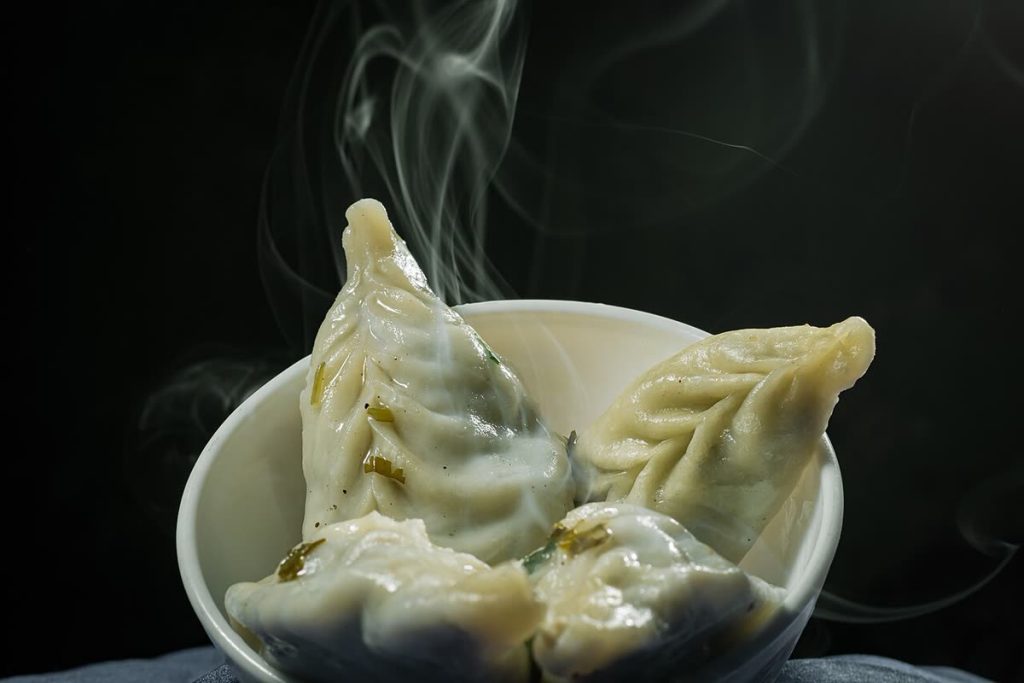
A momo is a small dumpling made from a thin wrapper of dough, filled with meat or vegetables, then pleated and steamed or sometimes fried. It is typically served with a spicy tomato or sesame chutney and sometimes a bowl of light broth. Its relatives include Chinese jiaozi and baozi, Mongolian buuz, Central Asian manti and Korean mandu, which tells you the idea travelled a long way along trade routes long before anyone wrote a recipe down.
The Tibetan roots
Tibetan cuisine developed in a cold, high-altitude environment where barley, butter, yak meat and dairy dominated. Wheat flour was less abundant, so dumplings with a protein filling were a practical, warming food. Many sources say that momos are Tibetan in origin, and the word itself is commonly said to come from Tibetan. Tibet’s long contact with Chinese neighbours, as well as with Nepal and Central Asia, almost certainly influenced the dish, and the cooking technique of steaming dumplings in tiered pots has parallels across the region.
Nepal and the Newar connection
Nepal is where momos truly became everyday food. A popular account links their arrival to trade between the Kathmandu Valley and Tibet, with Newar merchants carrying the recipe home. Newar cooks adapted it to local ingredients, using buffalo meat, local spices and distinctive dipping sauces. Today you will find momos in Nepal in many forms: steamed, fried, in soup, or coated in a spicy sauce known as chilli momo. Because accounts differ, it is fair to say Nepal developed its own tradition rather than simply copying Tibet.
How momos reached India and the wider world
- Himalayan towns: Sikkim, Darjeeling, Kalimpong and parts of Arunachal Pradesh and Ladakh already had Tibetan, Bhutanese and Nepali communities, so momos were established there early.
- After 1959: Tibetan refugees settled in Dharamshala, Delhi and other Indian cities and opened small eateries, bringing momos to new audiences.
- Delhi and metro cities: Street stalls adapted the recipe for local tastes, with tandoori and gravy versions.
- Global diaspora: Nepali and Tibetan restaurants in London, New York, Sydney and elsewhere introduced the dish to a wide public.
For readers interested in the broader background, Wikipedia has a helpful page on momo (food) that summarises the competing theories.
Regional styles at a glance
| Region | Typical filling | Common style |
|---|---|---|
| Tibet and Tibetan communities | Yak or beef, onion, ginger | Steamed, often larger and crescent-shaped |
| Nepal | Buffalo, chicken, vegetables, cheese | Steamed, fried, jhol (in soup) or chilli momo |
| Bhutan | Beef, pork, cabbage, cheese | Steamed, served with chilli sauce |
| Sikkim and Darjeeling | Pork, chicken, vegetables | Steamed, with clear soup on the side |
| Delhi and other Indian cities | Chicken, paneer, mixed vegetables | Steamed, fried, tandoori or in gravy |
Why the origin story is contested
Several things make a single answer unsafe. Dumpling-making spread across Asia over centuries, so cooks borrowed and adapted techniques rather than inventing a dish once. Oral histories differ between Tibetan, Nepali and Newar communities, and each emphasises its own role. Written records for ordinary food are thin, and modern brand marketing sometimes repeats tidy legends that are hard to verify. A careful answer is that momos took shape in the Himalayan cultural zone, with strong Tibetan and Nepali traditions, and that precise dates and inventors are unknown.
How to try and judge good momos
- Look for a thin but sturdy wrapper that is not gluey, with neat pleats on top.
- Check that the filling is juicy; steamed momos should release some savoury liquid when bitten.
- Try the chutney, which varies from fiery tomato and chilli to nutty sesame.
- Ask about vegetarian options and whether the steamer is shared if you have dietary needs.
- If you are making them at home, rest the dough for 30 minutes and steam for roughly 10 to 15 minutes depending on size.
Learning about a dish’s history can be as satisfying as eating it. If you like this kind of explainer, you might enjoy our look at what Vikings wore in winter, or the maths walkthrough on the determinant of an identity matrix.
Common misunderstandings
- Believing momos are “Chinese dumplings with a new name”. They share ancestry but have their own flavours, shapes and dips.
- Assuming every momo is steamed. Fried, tandoori and soup versions are common.
- Thinking one country owns the dish. Tibet, Nepal and neighbouring communities all have genuine claims.
- Treating internet dates and names as fact without sources.
Frequently asked questions
Are momos Tibetan or Nepali?
Both. Tibet is most commonly cited as the origin, while Nepal developed a rich, distinct tradition that many people now associate most strongly with the dish.
What does the word momo mean?
It is usually said to derive from a Tibetan word for a steamed bun or dumpling, though etymologies are debated.
How are momos different from dim sum?
Dim sum is a broad Cantonese meal style that includes many items. Momos are a specific dumpling type with Himalayan seasoning and dips.
Are momos healthy?
Steamed momos are lighter than fried ones, but nutrition depends on the filling, wrapper size and sauce. Check any nutritional information provided.
Can I make vegetarian momos?
Yes. Cabbage, carrot, mushrooms, paneer, tofu and spinach are all common fillings.
Conclusion
So, where did momos originate? The most defensible answer is the Himalayan region, with Tibet widely credited as the source and Nepal as the place where they flourished into an everyday staple. Enjoy them for what they are: a shared, evolving food that has crossed borders as easily as the people who cook it.
Key takeaways about where did momos originate
Here is a short summary of where did momos originate so you can find the main points quickly.
- A momo is a small dumpling made from a thin wrapper of dough, filled with meat or vegetables, then pleated and steamed or sometimes fried.
- Tibetan cuisine developed in a cold, high-altitude environment where barley, butter, yak meat and dairy dominated.
- Nepal is where momos truly became everyday food.
- For readers interested in the broader background, Wikipedia has a helpful page on momo (food) that summarises the competing theories.
Check official sources before acting on anything related to where did momos originate, because details can change over time.
Questions about where did momos originate are common, so it helps to compare more than one trustworthy source.
Use this page as a starting point for where did momos originate and come back to it when your situation changes.
Good decisions about where did momos originate come from checking the facts, comparing your options and taking your time.
Save this guide to where did momos originate so you can find it again whenever you need a quick reminder.
If you only remember one thing about where did momos originate, make it the practical steps covered in this guide.
Related reading:
For general background, you can look up where did momos originate on Wikipedia.