The history of flan stretches back to the Romans, who baked egg-based custards, and to medieval Europe, where “flan” described open pastry tarts as much as soft puddings. No one person or place invented the dish. The creamy caramel version most people picture today took shape in Spain and France and later spread through Latin America, picking up local flavours on the way. So the honest answer to where flan was invented is: Europe, over a long period, with Spain and the Roman world at the root of the story.
Key takeaways
- Egg custards go back to Roman times, and the word flan comes through Old French from a Latin-linked term for a flat cake.
- In medieval Europe, flans were often pastry cases with sweet or savoury fillings.
- The caramel-topped baked custard is most associated with Spain, with a close cousin in French crème caramel.
- Latin American countries developed their own versions, from coconut to cheese and dulce de leche.
Roman roots: custard before caramel
The earliest ancestors of flan are simple mixtures of eggs and milk or honey, baked gently until set. Roman cooks are known to have made egg custards, both sweet and savoury, and the Romans carried their cooking habits across their empire, including Spain, which they called Hispania. They kept hens and valued eggs, and a baked egg dish was practical, filling and easy to serve. These dishes were not the polished, glossy flan of a modern restaurant, but they used the same principle: eggs thicken a liquid when heated.
Where the word comes from
The English word flan comes from French, from Old French flaon, which in turn is linked to a Latin term meaning a flat cake, and is thought to have older Germanic roots. That is why, in English-speaking countries, a flan can be a pastry case filled with fruit or cheese, as in a “fruit flan” or “quiche-style flan”. In Spanish-speaking regions, flan nearly always means the baked caramel custard. The shared word hides two quite different dishes.
Medieval and early modern Europe
In the Middle Ages, flans were popular at banquets. Recipes often describe open pastry tarts filled with egg custard, cheese or spiced mixtures. Sweet and savoury were less strictly separated than now. Sugar was costly and its use signalled wealth, so a sweet custard was a statement dish. As sugar became cheaper through the following centuries, and as trade routes expanded, sweet custards became more common across social classes.
Spain and the caramel custard
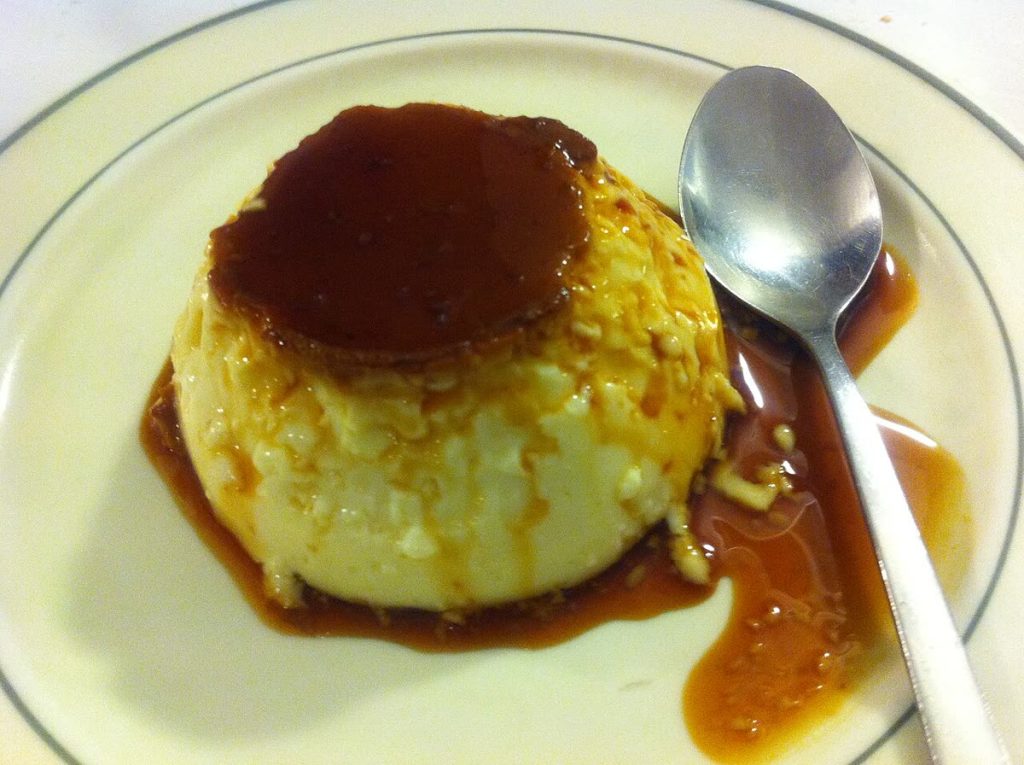
The version many people mean by flan is the one baked in a mould lined with caramel, then turned out so the caramel runs down the sides. This is strongly linked to Spain, where flan de huevo (egg flan) is a staple of home cooking and menus. Food historians point to the Roman egg custards as a background influence, together with the sugar-growing and sweet-making traditions that developed in medieval Iberia. The exact moment when caramel met custard is not pinned down by a single reliable record, and anyone who gives you a precise date or name should be treated with caution.
France has a close relative, crème caramel, which is similar in concept. Which came first is debated, and both belong to the same family of baked custards with caramel. For more on the wider family, the Wikipedia page on flan gives a good outline of the variations around the world.
Flan travels to the Americas
Spanish colonisation carried flan across the Atlantic. In Latin America it merged with local ingredients and tastes. Sugar cane plantations made caramel and sweet dishes widely available, and cooks adapted the recipe freely. Today, flan is a classic dessert in Mexico, Cuba, Puerto Rico, the Dominican Republic, Argentina, the Philippines (where leche flan is a celebration dish) and many other places. Some of these links reflect Spanish influence rather than direct copying, so the same dish may carry different names and styles in each country.
| Region | Common style | Typical twist |
|---|---|---|
| Spain | Flan de huevo | Simple eggs, milk, sugar and caramel |
| France | Crème caramel | Often lighter, with vanilla |
| Mexico | Flan napolitano | Uses cream cheese for a richer texture |
| Puerto Rico / Cuba | Flan de queso, coconut flan | Cheese or coconut added |
| Argentina | Flan mixto | Served with dulce de leche and cream |
| Philippines | Leche flan | Rich with egg yolks, often steamed |
| UK | Fruit or savoury flan | A pastry case filling |
How flan works: the science
Eggs are the structure of flan. When heated gently, egg proteins unfold and link up, trapping liquid and forming a gel. If the heat is too high or the cooking too long, the protein network tightens and squeezes water out, leaving a grainy, bubbly texture. That is why traditional recipes use a water bath, called a bain-marie, which keeps the temperature even and gentle. The caramel is made by cooking sugar until it melts and browns, and poured into the mould before the custard goes in. Once the dessert has chilled and set, inverting it releases the caramel as a sauce.
If you make flan at home and run short of an ingredient, our article on substituting eggs shows how eggs behave as a binder, but note that custard depends on eggs far more than meatballs do, so a swap is rarely perfect. Chilled desserts also need cold storage, so check your fridge setting with our guide to average temp for a fridge.
Make a simple flan at home
- Melt sugar in a pan over medium heat until it turns amber, then pour into a mould or ramekins and tilt to coat.
- Warm milk (and cream if you like) with vanilla.
- Whisk eggs and sugar, then slowly stir in the warm milk.
- Strain the mixture and pour it into the caramel-lined mould.
- Place the mould in a larger tray and add hot water to come partway up the sides.
- Bake at a low-to-moderate oven until the edges are set and the centre has a slight wobble.
- Cool, then chill for several hours before turning out.
Follow a trusted recipe for exact quantities and times, as ovens and moulds vary. Make sure the custard is cooked through and kept chilled; the USDA Food Safety and Inspection Service has advice on safe egg handling.
Frequently asked questions
Where was flan invented?
No single place is certain. Egg custards date to Roman times, and the caramel flan we know is strongly associated with Spain and France.
Is flan Spanish or Mexican?
The dessert came from Spain, but Mexico and other countries developed their own beloved versions, so it is popular in both.
What is the difference between flan and crème caramel?
They are very similar baked custards with caramel. Differences are small and vary by recipe and region.
Why is the word flan used for pastry in the UK?
The word came through French, where it referred to flat cakes and tarts. English kept the pastry meaning.
Is flan the same as custard?
It is a type of baked custard set with eggs, usually served with a caramel sauce.
Conclusion
The history of flan is a story of eggs, sugar and travel, with Roman beginnings, medieval tarts and a Spanish caramel custard that crossed oceans. Enjoy it knowing that every country’s version has a share in the story.
Key takeaways about history of flan
Here is a short summary of history of flan so you can find the main points quickly.
- The history of flan stretches back to the Romans, who baked egg-based custards, and to medieval Europe, where "flan" described open pastry tarts as much as soft puddings.
- The earliest ancestors of flan are simple mixtures of eggs and milk or honey, baked gently until set.
- The English word flan comes from French, from Old French flaon, which in turn is linked to a Latin term meaning a flat cake, and is thought to have older Germanic roots.
- In the Middle Ages, flans were popular at banquets.
If you only remember one thing about history of flan, make it the practical steps covered in this guide.
Check official sources before acting on anything related to history of flan, because details can change over time.
Questions about history of flan are common, so it helps to compare more than one trustworthy source.
Use this page as a starting point for history of flan and come back to it when your situation changes.
Good decisions about history of flan come from checking the facts, comparing your options and taking your time.
Save this guide to history of flan so you can find it again whenever you need a quick reminder.
Related reading:
- How Long Do Hot Dogs Boil? Timing, Method and Safety Tips
- What Is a Normal Pupil Size? A Simple Guide for Adults and Children
For general background, you can look up history of flan on Wikipedia.